
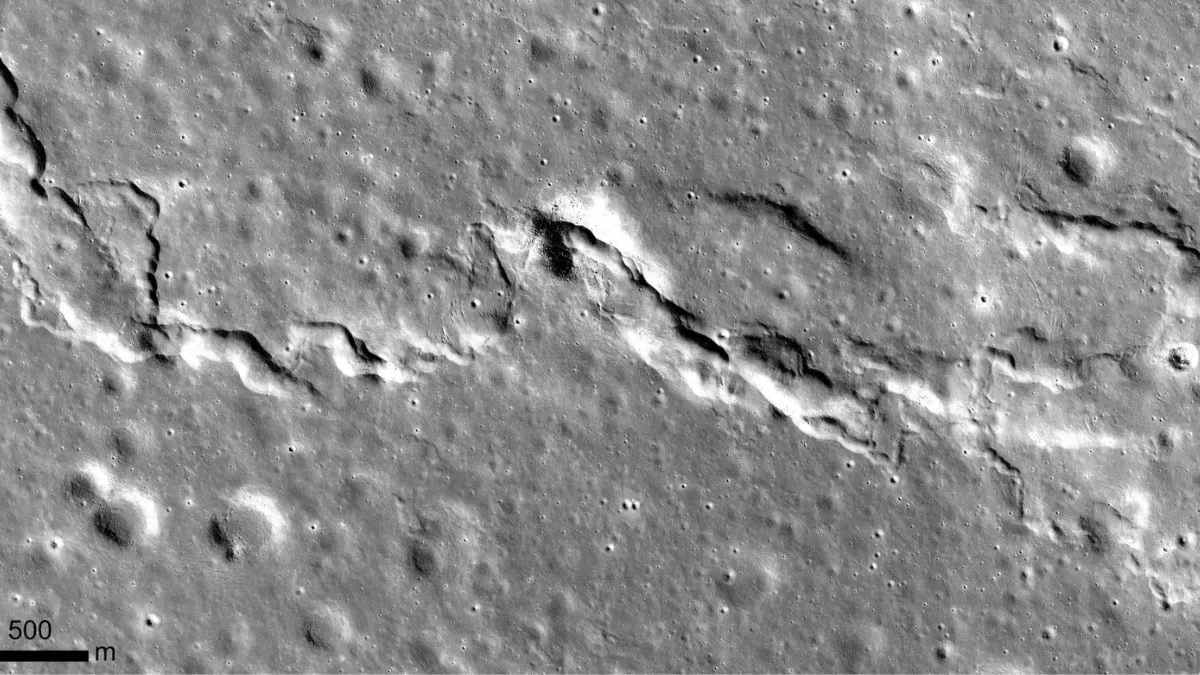
A new global map of small mare ridges has revealed exciting new information about the Moon’s tectonic activity. This groundbreaking study, conducted by a team of researchers, suggests that the Moon’s crust is still shrinking and that moonquakes could occur across much broader regions than previously believed. With over 1,100 previously unknown ridges identified, this discovery could have significant implications for future lunar missions, including the highly anticipated Artemis program.
The Moon has long been thought to be a geologically inactive celestial body, with its last volcanic activity occurring over a billion years ago. However, recent studies have challenged this notion, revealing evidence of tectonic activity and moonquakes. This new research, published in the journal Nature Geoscience, adds to the growing body of evidence that the Moon is far more dynamic than we once thought.
The team of researchers, led by Thomas Watters of the Smithsonian Institution’s National Air and Space Museum, used data from NASA’s Lunar Reconnaissance Orbiter (LRO) to create a comprehensive map of small mare ridges. These ridges, which are formed by thrust faults similar to lobate scarps, are evidence of the Moon’s crust shrinking as it cools and contracts. By analyzing high-resolution images from the LRO, the team was able to identify over 1,100 previously unknown ridges, covering a total length of more than 5,000 kilometers.
What makes this discovery even more significant is that these ridges are not limited to a specific region of the Moon. They are spread out across the lunar surface, indicating that the Moon’s tectonic activity is not only younger but also more widespread than previously believed. This suggests that moonquakes, which are caused by the release of energy from the Moon’s interior, could occur in many more areas than previously thought.
The implications of this study are far-reaching, especially for future lunar missions. With plans for human exploration and a permanent presence on the Moon through the Artemis program, understanding the potential risks of moonquakes is crucial. The findings from this study could reshape how space agencies assess seismic risks for future missions, including the safety of astronauts and equipment.
The Artemis program, named after the Greek goddess of the Moon, aims to land the first woman and the next man on the lunar surface by 2024. This ambitious mission also includes establishing a sustainable presence on the Moon, with plans for a lunar outpost and eventually a lunar base. With this new information about the Moon’s tectonic activity, NASA and other space agencies will need to carefully consider the potential risks and challenges that come with such endeavors.
But this discovery is not just important for future lunar missions. It also adds to our understanding of the Moon’s evolution and its place in the solar system. By studying the Moon’s tectonic activity, scientists can gain valuable insights into the processes that shape our neighboring celestial bodies. This could have implications for our understanding of other planets and moons in our solar system and beyond.
The team’s findings also highlight the importance of continued exploration and research of the Moon. The LRO, which has been orbiting the Moon since 2009, has been instrumental in providing valuable data and images for this study. As we continue to learn more about the Moon, we may uncover even more surprises and mysteries waiting to be solved.
In conclusion, the new global map of small mare ridges is a significant step forward in our understanding of the Moon’s tectonic activity. With over 1,100 previously unknown ridges identified, this study suggests that the Moon’s crust is still shrinking and that moonquakes could occur across much broader regions. The implications of this discovery for future lunar missions, including the Artemis program, are immense. It is an exciting time for lunar exploration, and this new research only adds to the anticipation and possibilities of what we may discover next.
