
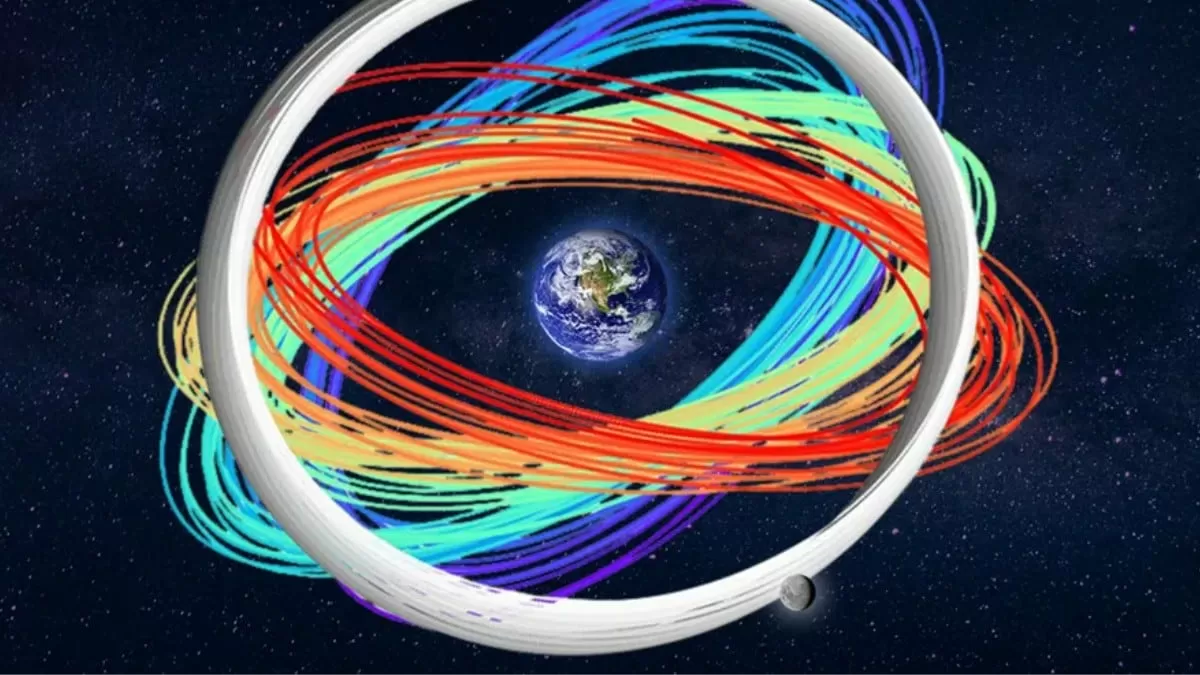
Scientists at Lawrence Livermore National Laboratory have made a groundbreaking discovery that could pave the way for future missions in cislunar space. Using advanced simulation techniques, they have assessed one million potential satellite orbits between Earth and the Moon and found that fewer than 10% remained stable over a period of six years. This highlights the challenges of operating in this environment, but also offers valuable insights for future missions.
The study, which was completed in just a matter of days using parallel supercomputers, provides a new roadmap for navigating the increasingly strategic Earth-Moon environment. This is a significant step forward in our understanding of cislunar space and its potential for exploration and development.
The Lawrence Livermore team used sophisticated algorithms and cutting-edge technology to simulate one million potential satellite orbits. This massive computation allowed them to identify roughly 97,000 viable orbits, which could serve as valuable options for future missions. This is a remarkable achievement and a testament to the power of modern computing.
Cislunar space, the region between Earth and the Moon, is becoming increasingly important for a variety of reasons. It offers a strategic vantage point for monitoring Earth’s climate and natural resources, as well as potential opportunities for space tourism and commercial activities. However, operating in this environment comes with its own set of challenges, as the Lawrence Livermore study has shown.
The team’s findings highlight the delicate balance required to maintain a stable orbit in cislunar space. With so many factors at play, including the gravitational pull of both Earth and the Moon, it is no surprise that only a small percentage of orbits remain stable over a period of six years. This underscores the need for careful planning and precise calculations when it comes to future missions in this region.
But the study also offers a glimmer of hope. The identification of 97,000 viable orbits provides a wealth of options for future missions, giving scientists and engineers a roadmap for navigating this complex environment. This is a significant development that could open up new possibilities for exploration and scientific research.
The use of parallel supercomputers to complete this study in just a matter of days is also worth noting. This demonstrates the incredible power and potential of modern computing technology. With the ability to process vast amounts of data and perform complex simulations, supercomputers are revolutionizing the way we approach scientific research and exploration.
The Lawrence Livermore study has not only provided valuable insights into cislunar space, but it has also highlighted the importance of collaboration and innovation in the scientific community. By bringing together experts from different fields and utilizing cutting-edge technology, we can achieve remarkable feats and push the boundaries of what is possible.
As we continue to explore and develop cislunar space, it is crucial that we do so in a responsible and sustainable manner. The Lawrence Livermore study has laid the foundation for future missions, but it is up to us to ensure that we do so in a way that minimizes our impact on this delicate environment.
In conclusion, the Lawrence Livermore National Laboratory’s simulation of one million potential satellite orbits between Earth and the Moon has provided valuable insights into the challenges and opportunities of operating in cislunar space. While only a small percentage of orbits remain stable over a period of six years, the identification of 97,000 viable orbits offers a new roadmap for navigating this increasingly strategic environment. This study is a testament to the power of collaboration and innovation in the scientific community, and it opens up new possibilities for future missions in cislunar space.
