
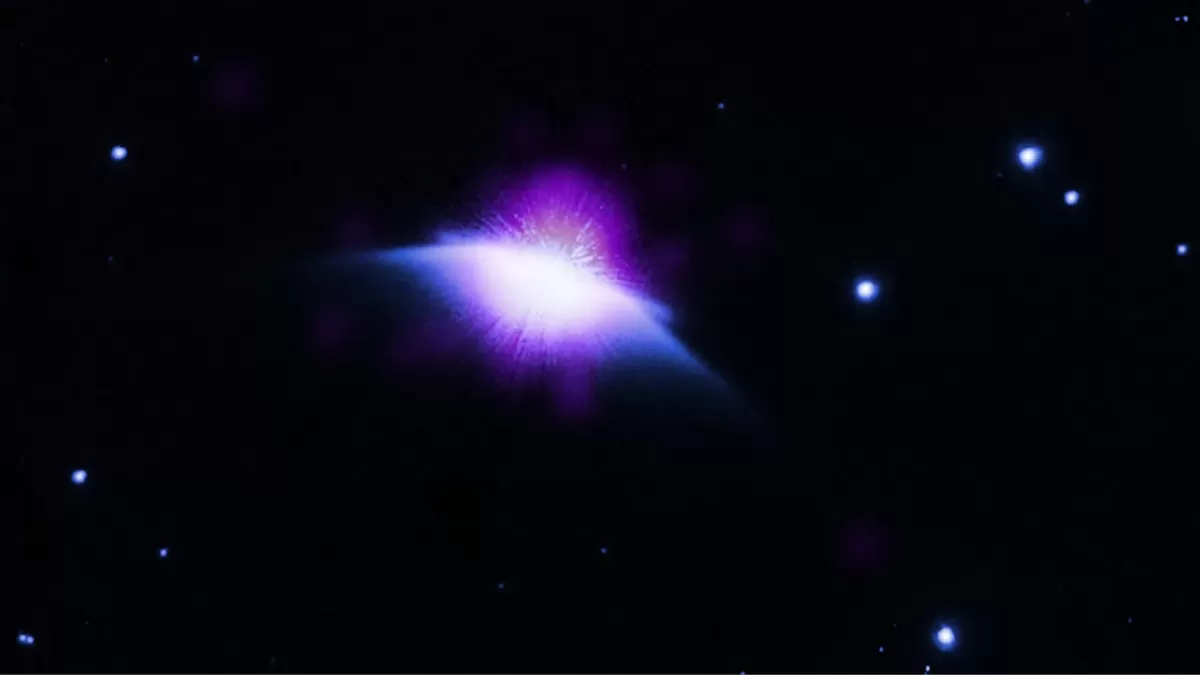
NASA astronomers have made an exciting discovery using the Chandra X-ray Observatory, a powerful space telescope. They have found a massive gas bubble surrounding a young star, HD 61005, which is about 100 million years old and located 120 light-years away from Earth. This discovery is shedding light on the early days of our solar system and providing valuable insights into the formation of our own Sun.
The Chandra X-ray Observatory, launched by NASA in 1999, is designed to capture high-energy X-rays from the universe. It is one of the most advanced telescopes in the world, and its latest discovery has once again proven its importance in the field of astronomy.
The star HD 61005, also known as the “Sun-like” star, is similar to our Sun in terms of size and age. However, it has a much stronger stellar wind, which is the stream of charged particles that flows from the star. This stellar wind is about 10 times stronger than the solar wind that we experience on Earth. As a result, it has created a massive bubble of hot gas, known as an astrosphere, around the star.
This astrosphere is about 200 astronomical units wide, which is equivalent to 200 times the distance between the Earth and the Sun. To put it into perspective, our solar system is only about 100 astronomical units wide. This means that the astrosphere around HD 61005 is twice the size of our entire solar system, making it a rare and remarkable find.
Scientists believe that this astrosphere is providing valuable insights into the early days of our own solar system. It is believed that our Sun also had a much stronger stellar wind in its early years, which shaped the formation of our solar system. By studying the astrosphere of HD 61005, astronomers can get a glimpse into the past and understand how our Sun may have influenced the formation of planets, including Earth.
Dr. David Huenemoerder, an astrophysicist at MIT and lead author of the study, explains, “The young Sun was much more active and had a stronger wind, so studying this astrosphere can help us understand how our solar system evolved.” He also adds, “It’s like looking at a baby picture of our own solar system.”
The discovery of this massive astrosphere also has implications for the search for life beyond Earth. The strong stellar wind around HD 61005 may have stripped away the atmosphere of any potential planets in its vicinity, making it difficult for life to exist. This highlights the importance of a stable and moderate stellar wind, like the one we experience from our Sun, in supporting life on a planet.
This discovery also showcases the power of technology in advancing our understanding of the universe. The Chandra X-ray Observatory has allowed astronomers to see beyond what is visible to the naked eye and explore the mysteries of the universe. It has played a crucial role in this groundbreaking discovery and will continue to do so in the future.
The findings of this study have been published in The Astrophysical Journal and have already created buzz among the scientific community. Scientists from different parts of the world are eager to study this astrosphere in more detail and unravel more secrets about our early solar system.
The discovery of the massive gas bubble surrounding HD 61005 is a testament to the ongoing efforts of NASA and its scientists to unravel the mysteries of the universe. It is a reminder of the vastness and complexity of our universe and how much we still have to learn. This discovery also serves as a motivation for future generations to continue pushing the boundaries of knowledge and exploring the unknown.
As we continue to make advancements in space technology, we can only imagine what other remarkable discoveries await us. The discovery of this astrosphere is a reminder that the universe is full of surprises and that there is always more to discover. Thanks to the Chandra X-ray Observatory and the dedicated efforts of NASA astronomers, we are one step closer to unlocking the secrets of our universe.
