
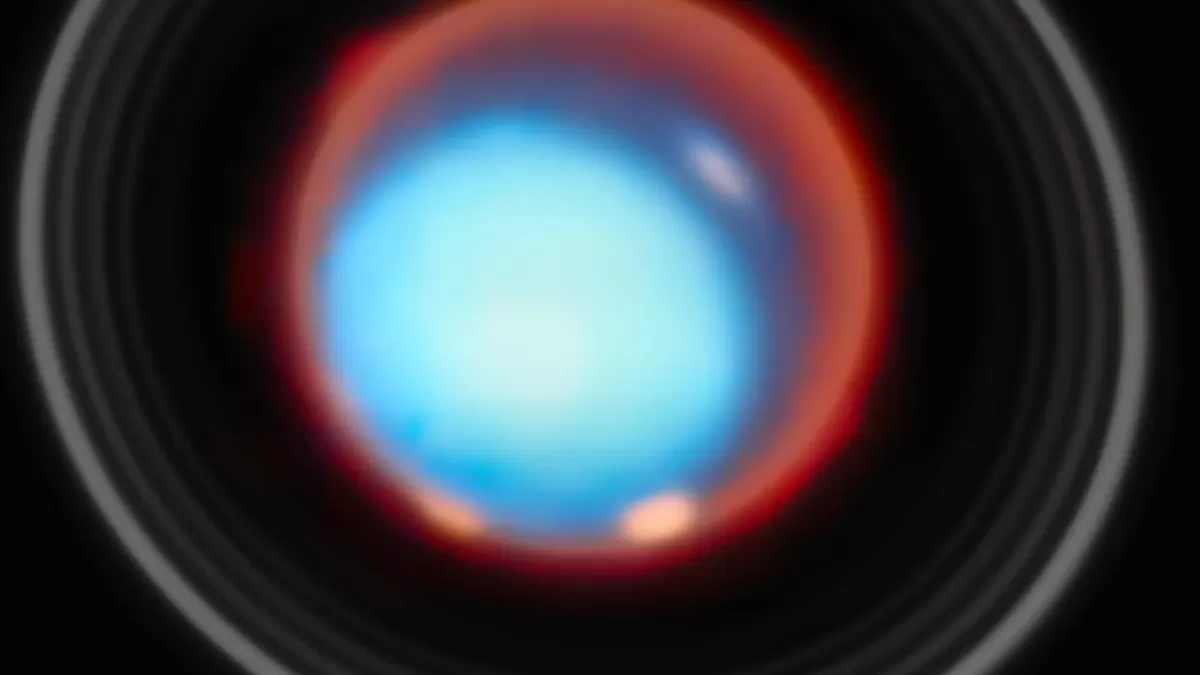
The James Webb Space Telescope (JWST) has once again made history by producing the first 3D map of Uranus’s upper atmosphere. This remarkable feat has allowed scientists to track temperatures and ion densities up to 5,000 kilometers above the planet’s clouds, providing valuable insights into the mysterious and complex world of Uranus.
Uranus, the seventh planet from the Sun, has long been a subject of fascination for scientists and stargazers alike. Its icy blue appearance and tilted axis have made it stand out among the other gas giants in our solar system. However, due to its distance from Earth and the limitations of previous telescopes, our understanding of this enigmatic planet has been limited.
But now, thanks to the advanced capabilities of the JWST, we have been able to obtain the most detailed and comprehensive view of Uranus to date. The telescope’s infrared instruments have allowed us to peer through the thick layers of the planet’s atmosphere, providing us with a deeper understanding of its composition and behavior.
One of the most striking discoveries from the JWST’s observations is the presence of bright auroras on Uranus. These stunning light shows are created by charged particles from the Sun interacting with the planet’s magnetic field. The 3D map has revealed that these auroras are shaped by Uranus’s tilted magnetic field, which is drastically different from the other planets in our solar system.
But the JWST’s observations have not just provided us with a visual spectacle. By tracking temperatures and ion densities in Uranus’s upper atmosphere, scientists have been able to confirm that the planet is slowly cooling over long timescales. This finding is significant as it adds to our understanding of the evolution and dynamics of Uranus’s atmosphere.
The JWST’s 3D map has also given us a closer look at the planet’s weather patterns. By tracking the movement of clouds and storms, scientists hope to gain a better understanding of the processes that drive the weather systems on Uranus. This information can also help us to predict future changes in the planet’s atmosphere.
Furthermore, the JWST’s observations have provided us with valuable data on the chemical composition of Uranus’s atmosphere. This information can help us to better understand the planet’s origins and its unique composition, which is primarily made up of hydrogen, helium, and methane.
The success of the JWST’s mission to map Uranus’s upper atmosphere is a testament to the incredible advancements in space technology. The telescope’s advanced instruments and capabilities have allowed us to obtain data that was previously unattainable. This achievement opens up new possibilities for further exploration and discovery in our solar system and beyond.
The 3D map of Uranus’s upper atmosphere is just the beginning. The JWST’s mission is ongoing, and scientists are eagerly waiting for more data and insights from this groundbreaking telescope. With its powerful instruments and advanced technology, the JWST is expected to revolutionize our understanding of the universe and bring us closer to answering some of the most fundamental questions about our existence.
In conclusion, the James Webb Space Telescope has once again pushed the boundaries of space exploration by producing the first 3D map of Uranus’s upper atmosphere. This remarkable achievement has given us a deeper understanding of the planet’s weather patterns, chemical composition, and magnetic field. As we continue to unravel the mysteries of Uranus, the JWST will undoubtedly play a crucial role in expanding our knowledge of our solar system and the universe beyond.
