
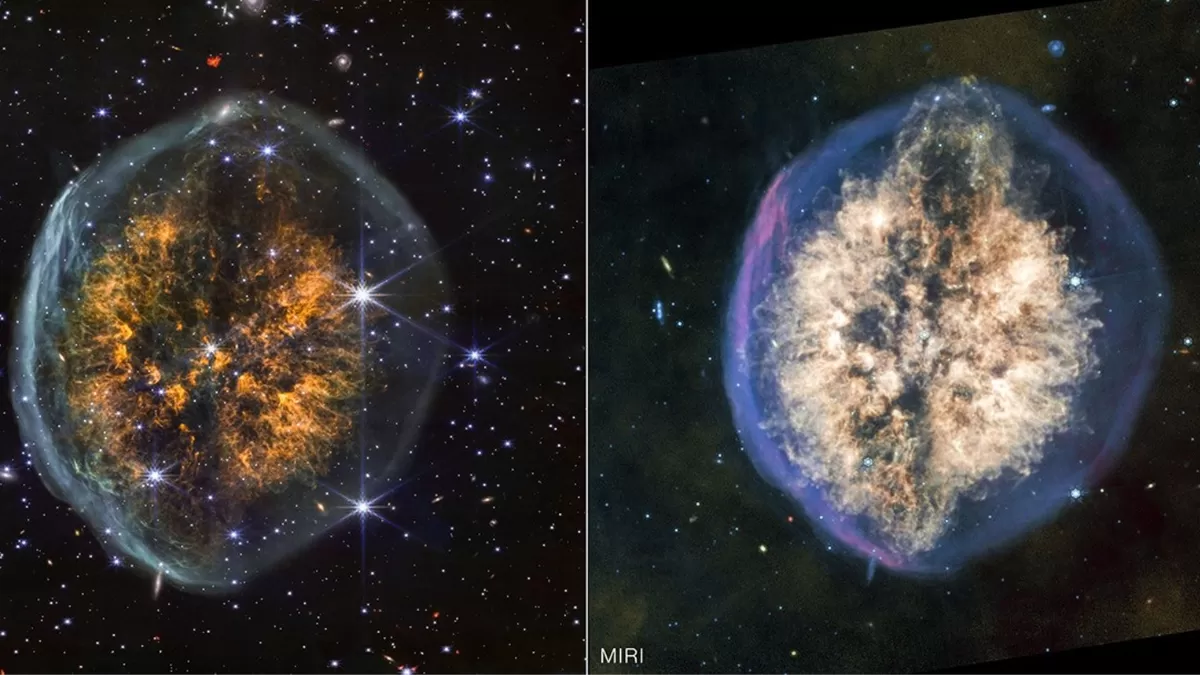
NASA’s James Webb Space Telescope has once again stunned the world with its remarkable capabilities. The latest achievement of this cutting-edge telescope is the capture of detailed infrared images of a planetary nebula known as PMR 1, nicknamed the “Exposed Cranium.” Located roughly 5,000 light-years away in the constellation Vela, the images provide fresh insight into the dramatic final phase of a dying star’s evolution.
The James Webb Space Telescope, often referred to as JWST, is a joint project by NASA, the European Space Agency (ESA), and the Canadian Space Agency (CSA). It was launched in December 2021 and has since been sending back breathtaking images from deep space. The primary goal of JWST is to study the early universe, but its advanced instruments have also allowed it to make significant contributions in various other areas of astrophysics.
In the recent study, conducted by a team of astronomers led by Dr. Alberto Noriega-Crespo of the Space Telescope Science Institute in Baltimore, Maryland, JWST has revealed the most detailed view of PMR 1 to date. This planetary nebula was first identified in 1967 by Argentine astronomer Guillermo Haro, who described it as having a structure resembling an exposed cranium with a skull and brain.
The new images captured by JWST show that Haro’s description was not far off. The inner “brain” region of the nebula is distinctly glowing, surrounded by a hydrogen gas shell. This central region is believed to be a hot, compact shell of gas and dust ejected by the dying star before it entered its final phase.
But perhaps the most fascinating aspect of the images is the dark lane that divides the glowing inner “brain” from the outer hydrogen shell. This lane is made up of ejected material from the star, providing astronomers with a closer look at the last moments of a dying star’s life. It is a rare and fortunate observation, as this stage of a star’s evolution is brief and fleeting.
The planetary nebula PMR 1 is an excellent example of a dying star’s final act. As stars age, they eventually run out of fuel and begin to expand, shedding their outer layers of gas and dust into space. The exposed core of the star, known as a white dwarf, then emits intense ultraviolet radiation, causing the surrounding gas to glow in various colors.
This process of expansion and emission creates beautiful and intricate structures, as seen in PMR 1. The dark lane dividing the “brain” from the hydrogen shell is formed when a burst of energy from the star, known as a shock wave, collides with the surrounding material, creating a shock boundary. This phenomenon is crucial to our understanding of the dynamics of planetary nebulae and the role they play in the universe.
The images captured by JWST not only provide a visual feast for the eyes but also valuable data for astronomers. The advanced infrared capabilities of the telescope allow scientists to study the chemistry and physical processes at play in the nebula. They can also determine the mass and composition of the gas and dust, providing insights into the star’s evolution before its death.
The success of this study is a testament to the groundbreaking technology of the James Webb Space Telescope. Its infrared capabilities allow it to see through dust and gas, providing a clear and detailed view of distant objects in space. With its precise instruments and advanced analytical tools, JWST continues to push the boundaries of our understanding of the universe.
The team of astronomers plans to continue studying PMR 1 with JWST, hoping to reveal more about the structure and composition of the nebula. They also aim to extend their observations to other planetary nebulae to gain a better understanding of this critical stage of a star’s evolution.
In conclusion, the stunning infrared images captured by NASA’s James Webb Space Telescope of the planetary nebula PMR 1, known as the “Exposed Cranium,” have provided fresh insights into the brief and dramatic final phase of a dying star’s evolution. This remarkable achievement is a testament to the cutting-edge technology of JWST and the dedication of the team of scientists behind it. With its continued exploration of deep space, JWST promises to uncover more secrets of the universe and inspire future generations to reach for the stars.
