
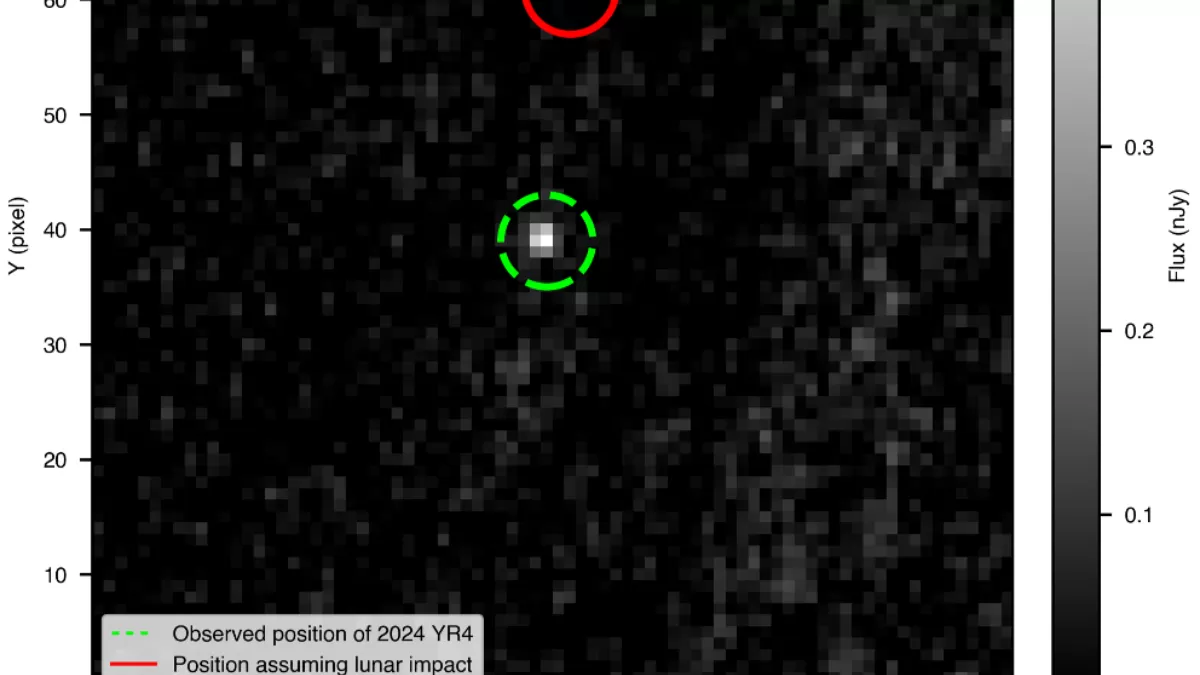
Infrared Observations from James Webb Space Telescope Confirm Safe Passage of Asteroid 2024 YR4 Near the Moon in 2032
The James Webb Space Telescope (JWST) has once again proven its worth as a powerful tool for space exploration. In a recent discovery, the telescope’s infrared observations have refined the orbit of asteroid 2024 YR4, providing crucial information about its trajectory and eliminating any concerns of a potential lunar impact.
Asteroid 2024 YR4 was first discovered in 2024 by the Catalina Sky Survey in Arizona. At the time, its orbit was not well understood and there were some concerns that it may collide with the Moon in December 2032. However, thanks to the advanced capabilities of the JWST, scientists were able to gather new data and refine the asteroid’s orbit with unprecedented accuracy.
The new observations from the JWST have revealed that asteroid 2024 YR4 will safely pass about 21,200 km above the Moon in December 2032. This distance is more than five times the Earth’s diameter and poses no threat to our natural satellite. This discovery has brought a sigh of relief to the scientific community and the general public alike, as the possibility of a lunar impact has been completely ruled out.
The JWST is the most powerful space telescope ever built, with a primary mirror that is six times larger than that of its predecessor, the Hubble Space Telescope. It is equipped with advanced infrared instruments that allow it to see through dust and gas clouds, providing a clearer view of distant objects in the universe. This makes it an invaluable tool for studying asteroids and other celestial bodies.
The refined orbit of asteroid 2024 YR4 was made possible by the telescope’s Near-Infrared Camera (NIRCam) and Near-Infrared Spectrograph (NIRSpec) instruments. These instruments were able to capture the asteroid’s thermal emissions, which helped scientists determine its size, shape, and composition. This information, combined with precise measurements of its position and velocity, allowed them to accurately predict its future trajectory.
The new data from the JWST has also helped to dispel earlier estimates that suggested a small chance of a lunar impact. These estimates were based on limited observations and did not take into account the asteroid’s thermal emissions, which can significantly affect its orbit. With the JWST’s advanced capabilities, scientists were able to gather a more complete picture of the asteroid’s orbit and confidently rule out any potential impact with the Moon.
This discovery highlights the importance of continued investment in space exploration and the development of advanced technologies like the JWST. With its unparalleled capabilities, the telescope has already made significant contributions to our understanding of the universe and will continue to do so in the years to come.
The safe passage of asteroid 2024 YR4 near the Moon in 2032 is not only a relief but also a reminder of the potential dangers that exist in our solar system. While this particular asteroid poses no threat, there are many others that could potentially collide with Earth. By studying and tracking these objects, we can better prepare for any potential impacts and protect our planet.
The JWST’s infrared observations have once again proven to be a game-changer in the field of space exploration. Its ability to refine the orbit of asteroid 2024 YR4 and eliminate any concerns of a lunar impact is a testament to the telescope’s advanced technology and the dedication of the scientists and engineers behind it. As we continue to push the boundaries of space exploration, the JWST will undoubtedly play a crucial role in unlocking the mysteries of the universe.
