
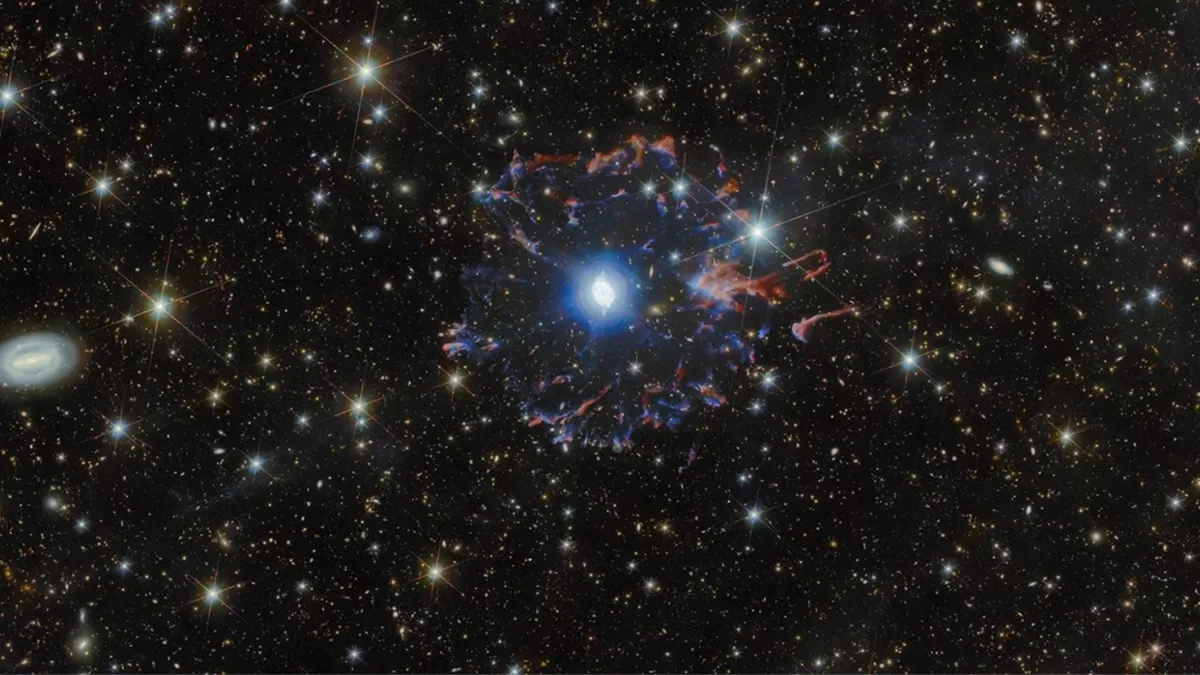
Astronomers have recently released a stunning image of the Cat’s Eye Nebula, thanks to a collaboration between the Hubble and Euclid space telescopes. This composite view provides a detailed look at the intricate structures within the nebula, including shells, jets, and a faint outer ring. The image also offers insight into the history of this dying star and its previous eruptions.
The Cat’s Eye Nebula, also known as NGC 6543, is a planetary nebula located in the constellation of Draco, approximately 3,000 light-years away from Earth. Planetary nebulae are formed when a star, in its final stages of life, sheds its outer layers of gas and dust. The Cat’s Eye Nebula is a prime example of this process, as it is the remnant of a star that was once similar in size to our own sun.
The new image, created by combining observations from the Hubble and Euclid space telescopes, offers a unique perspective on the Cat’s Eye Nebula. The Hubble Space Telescope, operated by NASA and the European Space Agency, captured the inner regions of the nebula, while the Euclid telescope, operated by the European Space Agency, provided a wider view of the outer regions.
The result is a breathtaking composite image that reveals the intricate structures within the nebula. The inner regions of the nebula are dominated by a series of concentric shells, which are believed to have been formed by multiple eruptions of the dying star. These shells are made up of gas and dust, and their intricate patterns are a result of the star’s varying mass loss over time.
In addition to the shells, the image also shows jets of gas streaming out from the central star. These jets are thought to be caused by the star’s magnetic fields, which can accelerate gas particles to high speeds. The jets are visible as bright, elongated features in the image, and they provide valuable insight into the dynamics of the nebula.
One of the most striking features of the Cat’s Eye Nebula is the faint outer ring, which is believed to have been formed by a previous eruption of the star. This outer ring is much larger than the inner shells and is thought to have been created when the star was in a different stage of its evolution. By studying this outer ring, astronomers hope to gain a better understanding of the star’s past and how it has evolved over time.
The collaboration between the Hubble and Euclid space telescopes has allowed astronomers to create a more complete and detailed image of the Cat’s Eye Nebula than ever before. By combining the strengths of these two telescopes, scientists have been able to capture both the inner and outer regions of the nebula, providing a more comprehensive view of this fascinating object.
This new image of the Cat’s Eye Nebula not only showcases the beauty of our universe but also provides valuable scientific data. By studying the intricate structures within the nebula, astronomers can gain a better understanding of the processes that occur during the death of a star. This, in turn, can help us to better understand the life cycle of stars and the formation of planetary nebulae.
The Cat’s Eye Nebula has long been a favorite among astronomers and stargazers alike, and this new image is sure to capture the imagination of many. Its intricate patterns and vibrant colors are a testament to the beauty and complexity of our universe. And with the continued advancements in technology and collaboration between space agencies, we can look forward to even more stunning images and discoveries in the future.
