
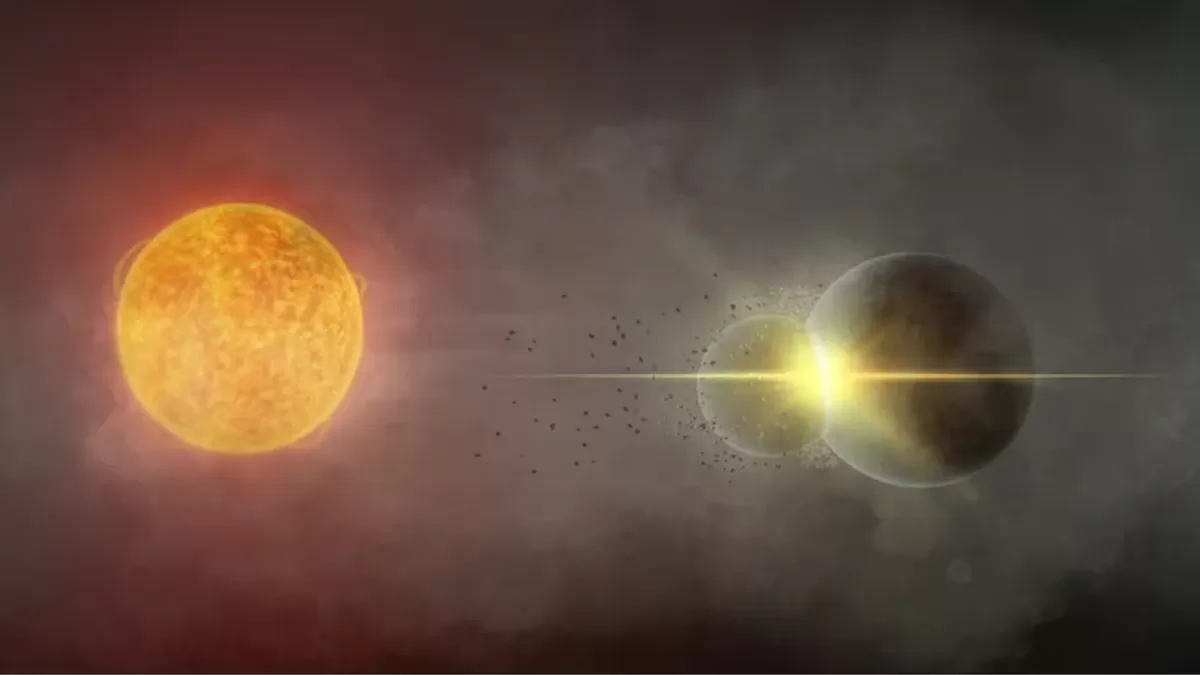
Astronomers have recently made an exciting discovery that sheds light on the violent and dynamic nature of our universe. Using data from the European Space Agency’s Gaia satellite, they have reported evidence of two planets colliding around a distant Sun-like star, Gaia20ehk. This star is located about 11,000 light-years away from Earth, making it a truly remarkable find.
The discovery was made when astronomers noticed a sudden change in the star’s light output. For years, the star’s brightness remained steady, but in 2016, it exhibited three minor dimming events. However, by 2021, the light curve of Gaia20ehk reportedly “went completely bonkers.” This unexpected behavior caught the attention of scientists, who then conducted follow-up observations to understand what was happening.
Their findings were astonishing. Infrared observations revealed a burst of heat coinciding with the fading of visible light from the star. This is a hallmark of a hot debris cloud resulting from a massive impact. The evidence strongly suggests that two planets collided around Gaia20ehk, causing a spectacular explosion that released a tremendous amount of energy.
This discovery is significant for several reasons. Firstly, it provides a rare opportunity for astronomers to witness a planetary collision in action. Such events are incredibly rare and usually occur in the early stages of a star’s life. Therefore, being able to observe one happening around a mature star like Gaia20ehk is a once-in-a-lifetime opportunity.
Secondly, this discovery adds to our understanding of how planets form and evolve. The debris cloud resulting from the collision is a treasure trove of information about the composition and structure of the two planets involved. By studying this debris, scientists can gain insights into the processes that shape our own solar system and others like it.
Moreover, this discovery also has implications for the search for life beyond our solar system. The two planets that collided around Gaia20ehk were likely rocky, similar to Earth. This means that such collisions could also occur in other star systems, potentially disrupting the conditions necessary for life to thrive. By studying these events, scientists can better understand the factors that contribute to the habitability of a planet.
The discovery of the planetary collision around Gaia20ehk is a testament to the power of modern technology and the dedication of astronomers. The Gaia satellite, launched in 2013, has been instrumental in this discovery, providing precise measurements of the star’s brightness over time. This data, combined with follow-up observations from ground-based telescopes, allowed scientists to piece together the puzzle of what happened around Gaia20ehk.
This discovery also highlights the importance of international collaboration in the field of astronomy. The Gaia satellite is a joint project of the European Space Agency and several international partners, including NASA. This global effort has enabled scientists to make groundbreaking discoveries and push the boundaries of our knowledge about the universe.
As we continue to explore the vast expanse of space, discoveries like this remind us of the wonders and mysteries that await us. The collision around Gaia20ehk is a reminder that our universe is a dynamic and ever-changing place, and we are fortunate to witness such events and learn from them.
In conclusion, the evidence of two planets colliding around Gaia20ehk, a distant Sun-like star located 11,000 light-years away, is a remarkable discovery that has captivated the scientific community. This event provides a unique opportunity to study a planetary collision in action and gain insights into the formation and evolution of planets. It also has implications for the search for life beyond our solar system. This discovery is a testament to the power of modern technology and international collaboration, and it reminds us of the endless possibilities that await us in the vastness of space.
