
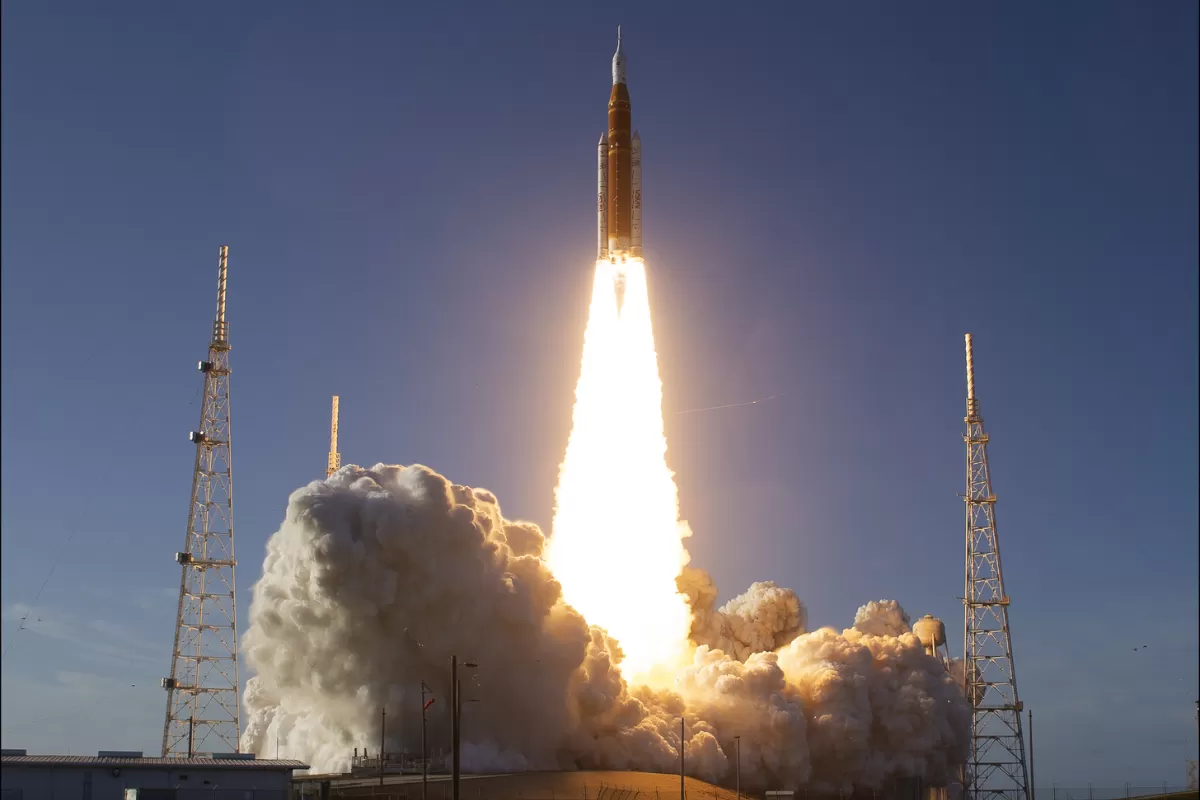
NASA’s Artemis II mission has officially set off towards the Moon, marking a significant milestone for the space agency. The successful launch of the new Space Launch System (SLS) rocket and the Orion spacecraft on Wednesday evening has made history, as it is the first crewed mission to the Moon in 50 years.
The momentous take-off took place at 6:35pm EDT (Thursday, 4:05am IST) from Launch Pad 39B at the Kennedy Space Center in Florida. The atmosphere was filled with excitement and anticipation as the rocket blasted off into the night sky, carrying the Orion spacecraft and four astronauts.
The mission, named after the Greek goddess of the Moon, is a part of NASA’s ambitious Artemis program, which aims to land the first woman and the next man on the lunar surface by 2024. This mission will serve as a stepping stone for future missions to Mars and other deep space destinations.
The Artemis II mission is the first crewed mission to use the SLS rocket, which is the most powerful rocket ever built by NASA. It stands at a staggering height of 322 feet and is capable of generating a thrust of 8.8 million pounds. The rocket is designed to carry heavy payloads and can send astronauts farther into space than any other rocket before.
The Orion spacecraft, which sits atop the SLS rocket, is a state-of-the-art vehicle that will transport astronauts to and from the Moon. It is equipped with advanced life support systems, a heat shield to protect the astronauts from extreme temperatures, and a powerful propulsion system to navigate through space. Orion is also capable of sustaining a crew of four for up to 21 days, making it the perfect vehicle for long-duration missions.
The successful launch of the Artemis II mission is a result of years of hard work and dedication by NASA’s team of engineers, scientists, and astronauts. The space agency has faced many challenges along the way, but their determination and perseverance have paid off.
The goal of the Artemis program is not only to send humans back to the Moon but also to establish a sustainable presence on its surface. NASA plans to build a lunar outpost, known as the Gateway, which will serve as a staging area for future missions to the Moon and beyond. The Gateway will also act as a testing ground for technologies that will be crucial for future missions, such as mining resources on the Moon and using them to sustain a human presence.
The Artemis II mission will orbit the Moon at an altitude of approximately 250,000 miles, which is further than any human has ever traveled from Earth. This will provide valuable data and insights for future missions, as well as give the astronauts a breathtaking view of the lunar surface.
The four astronauts on board the Orion spacecraft are Commander Shane Kimbrough, Pilot Megan McArthur, and Mission Specialists Thomas Pesquet and Akihiko Hoshide. They are all seasoned space veterans, with a combined total of 10 spaceflights between them. Their experience and expertise make them the perfect team to carry out this historic mission.
As the world watches in awe, the Artemis II mission serves as a reminder of humanity’s thirst for exploration and discovery. It is a testament to our ability to push the boundaries of what is possible and to reach for the stars. NASA’s Artemis program is not just about sending humans back to the Moon, but it is also about inspiring future generations to dream big and pursue careers in STEM fields.
The success of the Artemis II mission is a proud moment for not only NASA but also for the entire world. It is a reminder that with determination, hard work, and collaboration, we can achieve incredible feats. As we continue to journey towards the Moon and beyond, let us celebrate this moment and look forward to the exciting discoveries and advancements that lie ahead.
