
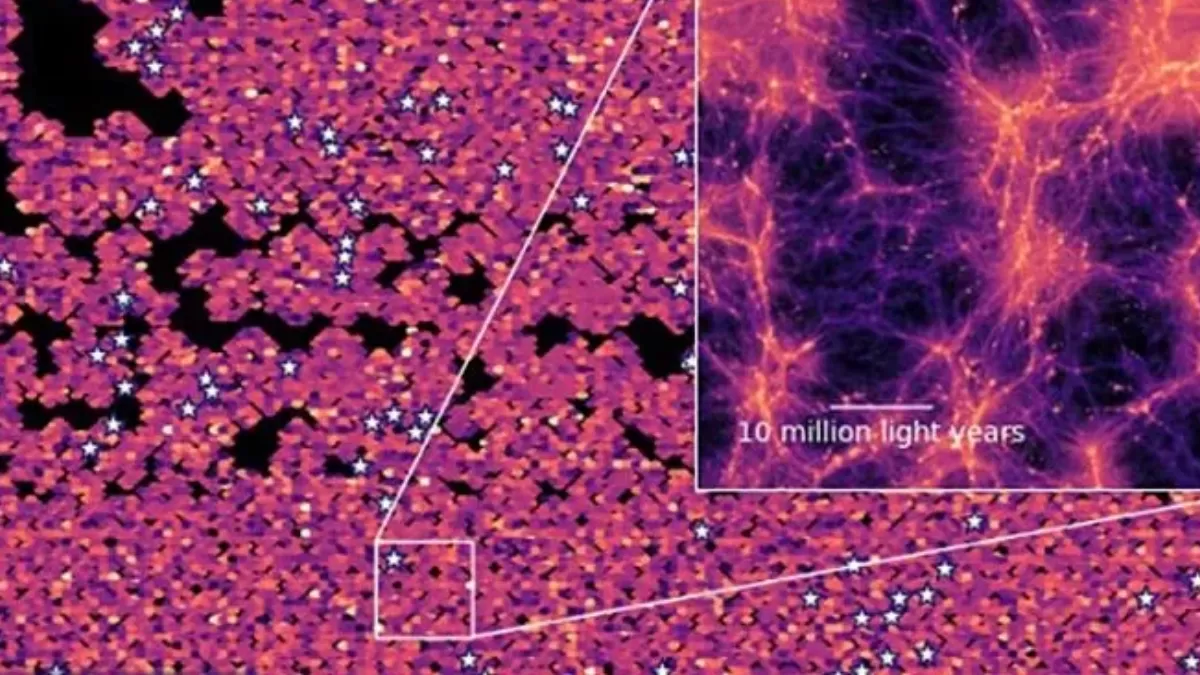
Astronomers have made a groundbreaking discovery that gives us a glimpse into the early universe and its peak star-forming era. Using data from the Hobby-Eberly Telescope Dark Energy Experiment (HETDEX), they have created the largest 3D map of hydrogen emission from the early universe. This map reveals large cosmic structures that existed about 9-11 billion years ago, providing us with valuable insights into the evolution of our universe.
The HETDEX project, which began in 2012, is a collaboration between the University of Texas at Austin, Pennsylvania State University, and the Max Planck Institute for Extraterrestrial Physics. Its main goal is to study dark energy, the mysterious force that is believed to be responsible for the accelerated expansion of the universe. However, the project has also been able to shed light on other important aspects of the universe, such as the early stages of star formation.
The map created by the HETDEX team covers a large portion of the sky, about one-third of the entire celestial sphere. It includes data from more than 35,000 galaxies, which were observed over a period of three years. The team used a specialized instrument called VIRUS (Visible Integral-field Replicable Unit Spectrograph) to collect the data. VIRUS is capable of capturing the spectra of multiple galaxies simultaneously, making it an ideal tool for mapping large areas of the sky.
The map reveals the distribution of neutral hydrogen gas, which is the most abundant element in the universe. This gas is the raw material from which stars are formed, and its distribution can tell us a lot about the conditions of the early universe. The data collected by HETDEX shows that the universe was a much more chaotic and turbulent place during its peak star-forming era than it is today. The map also reveals the presence of large cosmic structures, such as filaments and voids, which are the building blocks of the universe.
One of the most exciting findings of the HETDEX project is the detection of Lyman-alpha blobs (LABs). These are large, glowing clouds of hydrogen gas that are thought to be the birthplaces of massive galaxies. The HETDEX map has identified over 2,000 LABs, which is more than ten times the number previously known. This discovery will help astronomers better understand the formation and evolution of galaxies in the early universe.
The HETDEX map also provides valuable information about the properties of dark energy. By studying the distribution of galaxies and their velocities, the team was able to measure the expansion rate of the universe. This measurement is crucial in understanding the nature of dark energy and its role in the evolution of the universe.
The creation of this 3D map is a significant achievement for the HETDEX team and for the field of astronomy as a whole. It is the largest and most detailed map of its kind, and it will serve as a valuable resource for future studies of the early universe. The data collected by the HETDEX project will be made available to the public, allowing other researchers to use it for their own studies.
This groundbreaking discovery is a testament to the power of collaboration and technological advancements in the field of astronomy. The HETDEX project has brought together scientists from different institutions and countries to work towards a common goal. It also showcases the capabilities of the Hobby-Eberly Telescope, which is one of the world’s largest telescopes and has been instrumental in this discovery.
The HETDEX team’s achievement is a reminder that there is still so much to learn about our universe. With every new discovery, we get closer to understanding the mysteries of the cosmos. The 3D map of hydrogen emission from the early universe is a significant step towards unraveling the secrets of our universe’s past and shaping our understanding of its future. This discovery has opened up new avenues for research and has the potential to revolutionize our understanding of the universe.
