
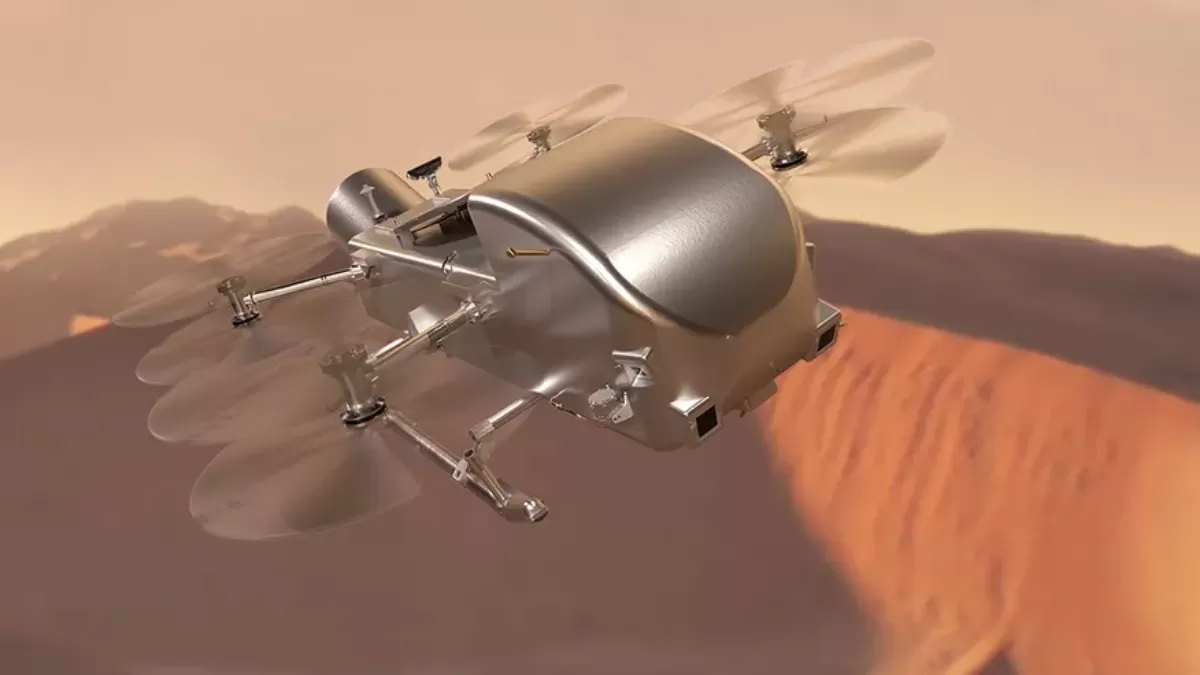
NASA has recently announced the start of construction for their latest mission, the Dragonfly project. This ambitious mission will utilize a nuclear-powered rotorcraft lander to explore the mysteries of Saturn’s largest moon, Titan. The car-sized drone is set to launch in 2028 and will embark on a six-year journey before finally reaching Titan in 2034. The Dragonfly mission is expected to provide groundbreaking insights into the composition and potential habitability of this intriguing celestial body.
The Dragonfly spacecraft is equipped with an innovative Multi-Mission Radioisotope Thermoelectric Generator (MMRTG), which will serve as its power source throughout the mission. This advanced technology will enable the spacecraft to conduct an extensive surface survey of Titan, gathering valuable data and images of the moon’s terrain.
Titan, with its thick atmosphere and hydrocarbon lakes, has always been a subject of fascination for scientists. However, due to its distance from Earth and harsh conditions, it has been a challenging task to explore this enigmatic moon. The Dragonfly mission aims to change that by providing a comprehensive and detailed exploration of Titan’s surface.
The spacecraft will utilize its rotorcraft capabilities to land at various locations on Titan, covering a total distance of over 175 kilometers. This will allow the mission to gather a wide range of data from different regions of the moon, providing a better understanding of its geology and potential for life. The MMRTG will ensure that the spacecraft has a continuous power supply, allowing it to operate for an extended period and conduct in-depth investigations.
One of the key objectives of the Dragonfly mission is to search for organic compounds on Titan’s surface. These compounds are essential building blocks of life and have been detected on the moon in the past. The mission will focus on areas near Titan’s equator, which is believed to have a higher concentration of these compounds. By analyzing the composition of the surface, scientists hope to gain insights into the moon’s potential for hosting life.
Another exciting aspect of the Dragonfly mission is its ability to explore Titan’s diverse landscapes. The moon is known to have a variety of terrains, including dunes, mountains, and lakes. The spacecraft’s advanced instruments will provide high-resolution images and collect data, allowing scientists to study these features in detail. This will help in understanding the geological processes that have shaped Titan and provide clues about its evolution.
The Dragonfly mission is also expected to provide valuable information about Titan’s atmosphere. The moon’s thick atmosphere is composed mainly of nitrogen, with traces of methane and other hydrocarbons. The spacecraft will analyze the chemical composition of the atmosphere and study its dynamics, providing insights into the moon’s weather patterns and potential for atmospheric processes.
The data collected by the Dragonfly mission will not only enhance our understanding of Titan but also help in studying other celestial bodies in our solar system. The advanced technology and instruments used in this mission will pave the way for future exploration and provide a blueprint for conducting similar missions in the future.
The Dragonfly mission is a result of years of research and development by NASA’s team of scientists and engineers. It is a testament to their dedication and determination to push the boundaries of space exploration. The mission also highlights the collaboration between NASA and its international partners, such as the European Space Agency, who have contributed to the success of this project.
As we look forward to the launch of the Dragonfly spacecraft in 2028, we can’t help but feel excited about the possibilities that lie ahead. This mission has the potential to revolutionize our understanding of Titan and provide valuable insights into the origins of our solar system. It is a significant step towards unraveling the mysteries of the universe and a testament to humanity’s innate curiosity and thirst for knowledge.
In conclusion, NASA’s Dragonfly mission is a groundbreaking project that promises to uncover the secrets of Saturn’s largest moon, Titan. With its advanced technology and instruments, the mission is expected to provide a comprehensive and detailed exploration of the moon’s surface, atmosphere, and potential for life. The mission’s success will not only expand our knowledge of Titan but also pave the way for future space exploration missions. The countdown to 2028 has begun, and we can’t wait to see what the Dragonfly spacecraft will reveal about this intriguing celestial body.
