
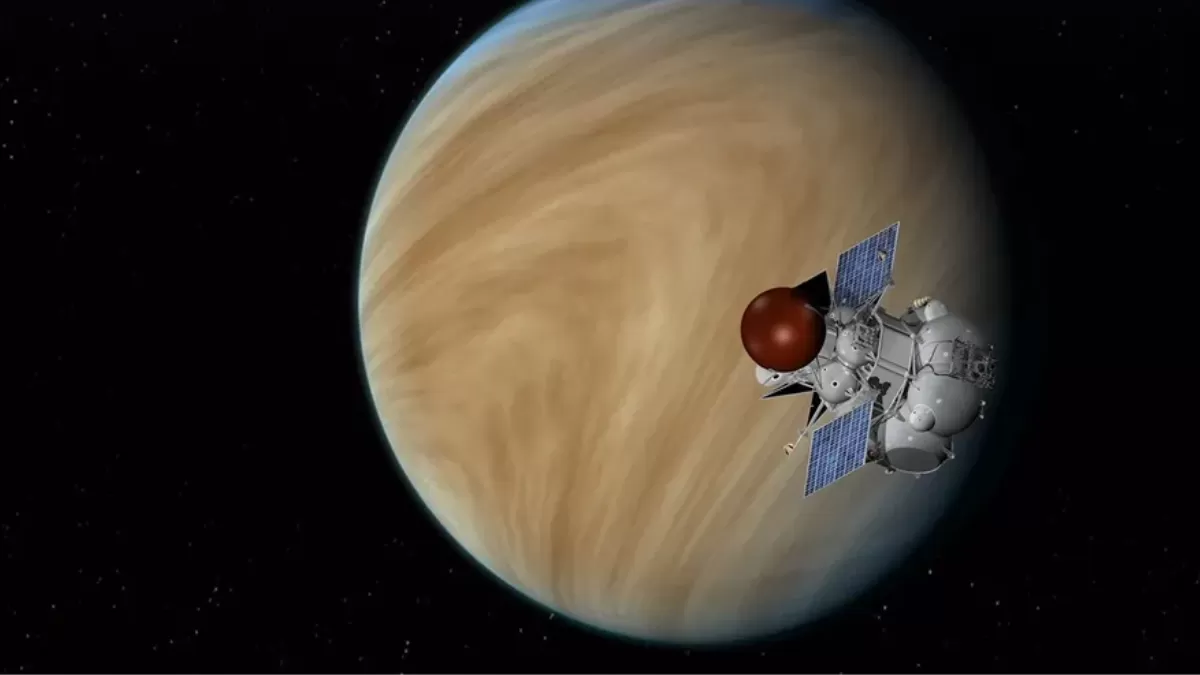
Russia, known for its pioneering efforts in space exploration, is preparing for yet another ambitious mission – the Venera-D mission to Venus. This mission, planned to launch in 2036, is set to continue the legacy of Soviet Venus exploration and push the boundaries of scientific research.
The Venera-D mission, led by the Russian Federal Space Agency (Roscosmos), will involve an orbiter, balloon probe, and lander, making it one of the most comprehensive missions to Venus to date. The ultimate goal of this mission is to study the atmosphere, clouds, and surface of Venus, while also searching for possible signs of microbial life.
Venus, often referred to as Earth’s “sister planet” due to its similar size, is considered one of the most mysterious and inhospitable places in our solar system. With surface temperatures reaching a scorching 465 degrees Celsius and a dense, toxic atmosphere, it has been a challenging destination for space exploration. However, this has not deterred scientists from trying to unravel the secrets of this fascinating planet.
The Venera-D mission will focus on three main objectives: studying the atmosphere, searching for signs of life, and examining the planet’s surface. The orbiter will carry a suite of instruments that will study Venus’s atmosphere, including its composition, dynamics, and weather patterns. This will provide valuable insights into the planet’s extreme climate and help us better understand the processes that have shaped its atmosphere.
The balloon probe, known as the Vega-D, will be the first of its kind to be deployed on Venus. It will float through the planet’s thick clouds, gathering data on their composition and properties. This will give us a better understanding of the atmospheric conditions on Venus and how they compare to those on Earth.
The most exciting aspect of the Venera-D mission is the lander, which will be equipped with a range of scientific instruments to study the planet’s surface. This includes a high-resolution camera to capture images of the rugged terrain and a seismometer to monitor any seismic activity. But perhaps the most significant aspect of the lander is its ability to search for signs of microbial life. This has been a long-standing question in the scientific community, and the Venera-D mission aims to provide some answers.
One of the most crucial aspects of this mission is its continuation of the Soviet exploration of Venus. The Venera program, which ran from the 1960s to the 1980s, was a series of successful missions that provided valuable data on Venus’s atmosphere and surface. The Venera-D mission will build on this legacy and use the latest technologies and advancements in space exploration to delve deeper into the mysteries of Venus.
The Venera-D mission has already received international support and collaboration, with organizations such as NASA and the European Space Agency (ESA) contributing to its success. This mission will not only advance our understanding of Venus but also provide valuable insights into the evolution of our own planet and the solar system.
As we look towards the future, the Venera-D mission serves as a reminder of the importance of scientific exploration and cooperation. It is a testament to the human spirit of curiosity and innovation and a step towards uncovering the secrets of our universe.
In conclusion, Russia’s plan to launch the Venera-D mission to Venus in 2036 is an exciting and ambitious mission that holds great promise for scientific discovery. With its comprehensive approach and focus on studying the planet’s atmosphere, surface, and the possibility of life, this mission will undoubtedly leave a mark on the history of space exploration. We eagerly await the launch of this mission and the valuable insights it will bring to our understanding of Venus and the universe.
