
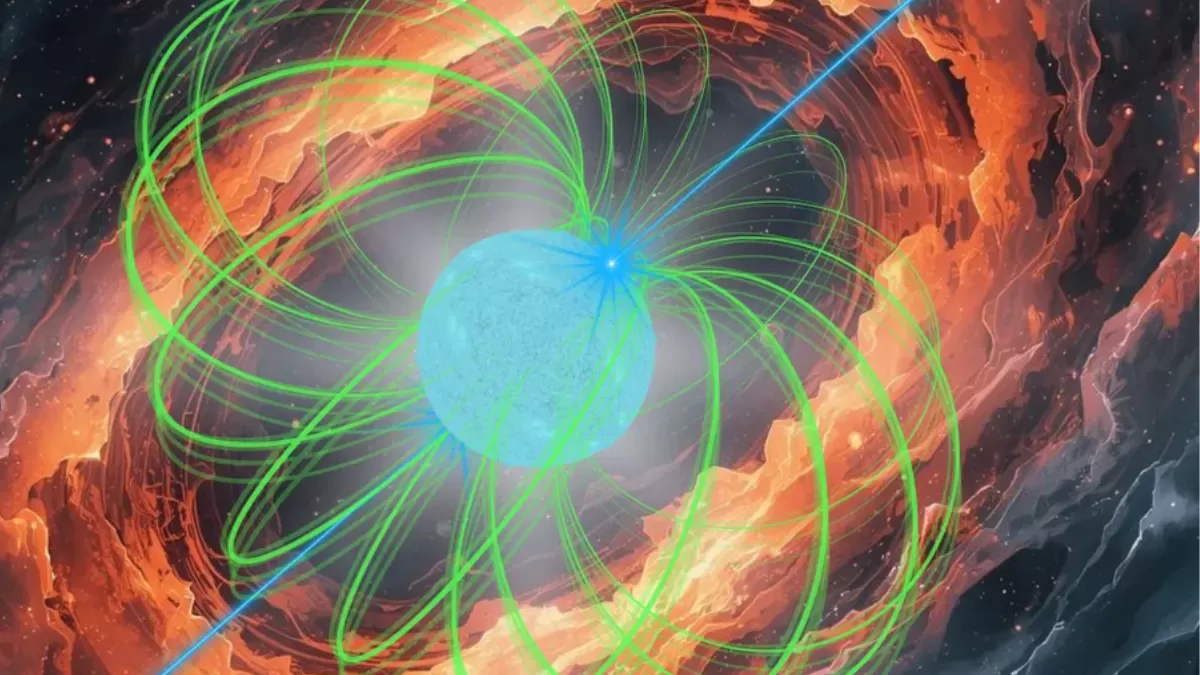
Astronomers have made a groundbreaking discovery that could change our understanding of pulsars and the universe as we know it. Pulsars, also known as neutron stars, are incredibly dense and rapidly spinning celestial objects that emit beams of electromagnetic radiation. These beams are often observed as radio waves, and until now, it was believed that they were only emitted from the magnetic poles of pulsars. However, a recent study has revealed that these fast-spinning pulsars are capable of emitting radio waves far beyond their magnetic poles, reaching the edges of their magnetic fields.
This finding, published in the journal Nature, challenges long-held theories about pulsars and could have significant implications for our understanding of the universe. It was made possible by a team of international researchers who used the Low Frequency Array (LOFAR) telescope in the Netherlands to observe a pulsar known as PSR B0943+10.
The team, led by astronomer Jason Hessels from the University of Amsterdam, discovered that the radio waves emitted by PSR B0943+10 were not confined to its magnetic poles, as previously thought. Instead, they were able to detect radio waves coming from the edges of the pulsar’s magnetic field, which is a significant distance away from its poles.
This discovery has challenged the long-held belief that pulsars only emit radio waves from their magnetic poles. It also raises questions about how these beams are generated and why they are not confined to the poles. According to Hessels, this finding could lead to a better understanding of the complex physics behind pulsars and their emission mechanisms.
But the implications of this discovery go beyond just understanding pulsars. It could also have a significant impact on our ability to detect gravitational waves. Gravitational waves are ripples in the fabric of space-time, predicted by Einstein’s theory of general relativity. They are created by the most violent and energetic events in the universe, such as the collision of two black holes or the explosion of a supernova.
Since the first detection of gravitational waves in 2015, scientists have been working to improve their detection methods. One of the most promising techniques is to use pulsars as cosmic clocks. Pulsars are incredibly precise in their rotation, making them ideal for detecting tiny disturbances in space-time caused by passing gravitational waves.
However, the current methods of using pulsars to detect gravitational waves are limited by the assumption that the radio waves are only emitted from the magnetic poles. This new discovery challenges that assumption and could lead to a more accurate and efficient way of detecting gravitational waves.
Furthermore, this finding could also help scientists discover more pulsars. Pulsars are notoriously difficult to detect, and this discovery could open up new avenues for their detection. By looking for radio waves emitted from the edges of their magnetic fields, astronomers could potentially find more pulsars that were previously undetectable.
This discovery is a testament to the power of international collaboration and the advancements in technology that have allowed us to observe the universe in ways we never thought possible. It also highlights the importance of challenging long-held theories and pushing the boundaries of our knowledge.
As we continue to unravel the mysteries of the universe, discoveries like this one remind us that there is still so much we have yet to understand. With each new breakthrough, we come one step closer to unlocking the secrets of the cosmos.
In conclusion, the discovery that fast-spinning pulsars emit radio waves far beyond their magnetic poles is a significant milestone in our understanding of these enigmatic objects. It challenges long-held theories, opens up new possibilities for gravitational wave detection, and could lead to the discovery of more pulsars. This discovery is a testament to the ingenuity and perseverance of scientists and reminds us that there is still so much left to discover in the vast expanse of our universe.
