
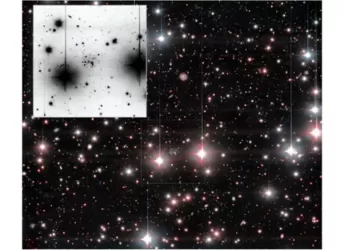
A team of astronomers have made a groundbreaking discovery that could shed light on the early universe and the mysterious substance known as dark matter. They have uncovered a new satellite galaxy, named Andromeda XXXVI, orbiting the larger Andromeda galaxy. This ultra-faint and dark matter-rich system holds the key to understanding the formation of galaxies and the role of dark matter in the universe.
The Andromeda galaxy, also known as M31, is the closest spiral galaxy to our Milky Way, located about 2.5 million light-years away. It is a popular target for astronomers as it offers a unique opportunity to study the evolution of a galaxy similar to our own. The newly discovered satellite, Andromeda XXXVI, is located on the outskirts of the Andromeda galaxy and was spotted using data from the Panoramic Survey Telescope and Rapid Response System (Pan-STARRS) in Hawaii.
Andromeda XXXVI is an ultra-faint galaxy, meaning it is extremely faint and has low luminosity. In fact, it is one of the faintest galaxies ever detected, with a luminosity of only about 0.05% of the Milky Way. Its dimness is what makes it difficult to spot and is the reason why it has eluded astronomers until now. However, its faintness is not the only intriguing aspect of this satellite. It is also incredibly rich in dark matter.
Dark matter is a mysterious substance that makes up about 85% of the matter in the universe. It does not emit, absorb, or reflect light, making it invisible to telescopes. Its existence is inferred by its gravitational effects on visible matter, such as stars and galaxies. Scientists believe that dark matter played a crucial role in the formation of galaxies, and studying it can help us understand the structure and evolution of the universe.
Dr. Alan McConnachie, an astronomer at the National Research Council of Canada, and his team have been studying the Andromeda galaxy for years, hoping to find new satellite galaxies. The discovery of Andromeda XXXVI is a significant milestone in their research. Dr. McConnachie said, “Finding this galaxy was like finding a needle in a haystack. It is a small and faint object, and it took us a long time to confirm its existence. But once we did, we were thrilled.”
The team used the Gemini North telescope in Hawaii to measure the motion of stars in Andromeda XXXVI. By analyzing the speeds of these stars, they could determine the galaxy’s mass, and to their surprise, it turned out to be mostly dark matter. Dr. McConnachie added, “We were amazed by how much dark matter this galaxy contains. It is almost entirely made up of this elusive substance, with very few stars.”
This finding makes Andromeda XXXVI a rare and valuable object for astronomers. It is one of only a handful of galaxies known to have a dark matter fraction of more than 99%. Dr. McConnachie explained, “Most galaxies, including our own Milky Way, have a dark matter fraction of around 85%. But Andromeda XXXVI is an exceptional case, and studying it could provide crucial insights into how galaxies form and evolve.”
According to the team’s calculations, Andromeda XXXVI is an ancient galaxy, with stars that are over 10 billion years old. This makes it one of the oldest satellite galaxies ever discovered. Dr. McConnachie believes that this galaxy could be a fossil from the early universe, providing a glimpse into the conditions that existed during the formation of the first galaxies.
The discovery of Andromeda XXXVI has opened up new opportunities for researchers to study the relationship between dark matter and galaxy formation. Dr. McConnachie said, “This galaxy is like a time capsule, preserving the conditions of the early universe. By studying it, we can learn more about the role of dark matter in the formation and evolution of galaxies.”
This groundbreaking discovery has been published in The Astrophysical Journal, and it has already garnered attention and excitement from the scientific community. Dr. James Bullock, a cosmologist at the University of California, said, “This is an incredibly significant finding. Andromeda XXXVI is a rare and unique galaxy, and it has the potential to provide groundbreaking insights into the mysteries of dark matter.”
The next step for Dr. McConnachie and his team is to study Andromeda XXXVI in more detail
