
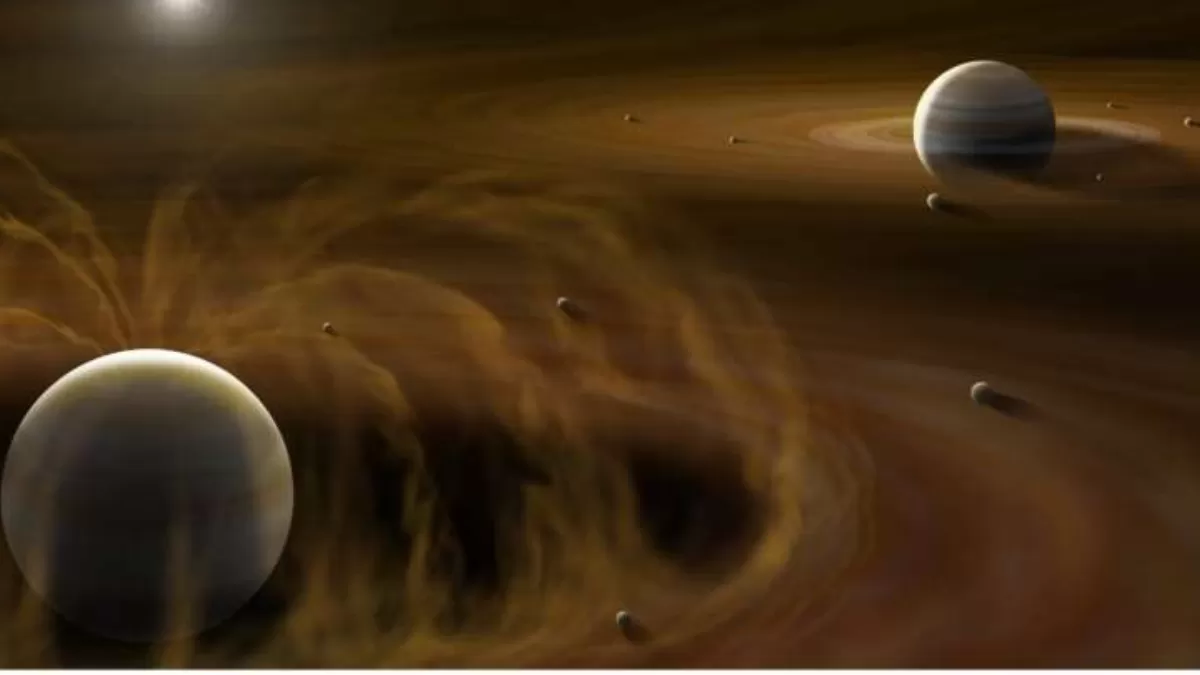
Scientists have made a groundbreaking discovery that could change the way we search for exomoons in distant planetary systems. According to a recent study, the strong magnetic field of Jupiter may have played a crucial role in creating regions for multiple large moons to form, unlike its neighbor Saturn.
Jupiter, the largest planet in our solar system, is known for its strong magnetic field, which is about 20,000 times stronger than Earth’s. This magnetic field is created by the rapid rotation of the planet and its metallic hydrogen core. Saturn, on the other hand, has a weaker magnetic field, only about 1/20th of Jupiter’s.
In the past, scientists believed that the formation of large moons around gas giants like Jupiter and Saturn was a random process. However, the new study, published in the journal Nature Astronomy, suggests otherwise. The researchers found that the strong magnetic field of Jupiter may have created a “magnetosphere”, a region where charged particles are trapped and guided along the planet’s magnetic field lines.
This magnetosphere acts as a shield, protecting the moons from the solar wind and other cosmic particles. As a result, the moons were able to form and remain in stable orbits without being disrupted. In contrast, Saturn’s weaker magnetic field was unable to provide the same protection, leading to the formation of fewer and smaller moons.
The study was conducted by a team of researchers from the University of California, Berkeley, and the University of Bordeaux in France. They used computer simulations to mimic the conditions of the early solar system and found that Jupiter’s strong magnetic field played a crucial role in creating a stable environment for moon formation.
This discovery has significant implications for the search for exomoons, which are moons orbiting planets outside of our solar system. In the past, astronomers have primarily focused on finding exoplanets, but the existence of exomoons has also been theorized. However, the search for exomoons has been challenging due to the lack of a clear understanding of how they form.
With this new information, astronomers can now expand their search to planetary systems with gas giants similar to Jupiter, as these systems are more likely to have multiple large moons. This finding could also help in understanding the diversity of moons in our own solar system, as well as in other planetary systems.
Dr. Stephen Kane, an astronomer at the University of California, Riverside, who was not involved in the study, said, “This is an exciting discovery that could reshape our understanding of moon formation. It opens up new possibilities for future exomoon discoveries and could provide valuable insights into the formation and evolution of our own solar system.”
The study also has implications for the search for habitable worlds outside of our solar system. Large moons, like Jupiter’s Europa and Saturn’s Enceladus, are believed to have subsurface oceans that could potentially harbor life. With the discovery that Jupiter’s strong magnetic field played a crucial role in creating these moons, it raises the possibility of finding similar habitable moons around other gas giants.
The search for exomoons is still in its early stages, and there is much that we do not know. However, this groundbreaking study has provided a new perspective on moon formation and could lead to significant discoveries in the future. With the advancement of technology and more powerful telescopes, we may soon be able to confirm the existence of exomoons and learn more about these mysterious worlds.
In conclusion, the strong magnetic field of Jupiter has been found to have a significant impact on the formation of multiple large moons, unlike its neighbor Saturn. This discovery has the potential to reshape our understanding of moon formation and could greatly aid in the search for exomoons. The study also opens up new possibilities for exploring the diversity of moons in our solar system and beyond. As we continue to unravel the mysteries of the universe, this groundbreaking discovery will undoubtedly play a crucial role in shaping our future understanding of the cosmos.
