CERN Experiments Confirm Early Universe Behaved Like a Near-Perfect Fluid
Physicists at CERN have directly observed fluid-like behaviour in the quark–gluon plasma that filled the early universe. Experiments at the Large Hadron Collide...
Physicists at CERN have made a groundbreaking discovery that sheds light on the early universe. Through experiments at the Large Hadron Collider, they have directly observed fluid-like behavior in the quark-gluon plasma that filled the universe shortly after the Big Bang. This confirmation of a near-perfect, low-friction fluid state in the primordial "soup" of quarks and gluons validates decades of theoretical predictions and opens up new avenues for understanding the fundamental nature of our universe.
The quark-gluon plasma is a state of matter that existed in the first few microseconds after the Big Bang, when the universe was extremely hot and dense. In this state, the building blocks of matter, quarks and gluons, were not confined within particles as they are today. Instead, they moved freely and interacted with each other in a fluid-like manner.
For years, scientists have been trying to recreate this state in the laboratory in order to study its properties and gain a better understanding of the early universe. The Large Hadron Collider (LHC) at CERN, the European Organization for Nuclear Research, is the world's largest and most powerful particle accelerator, and it has been instrumental in these efforts.
Using the LHC, physicists were able to collide heavy ions, such as lead nuclei, at extremely high energies, creating a tiny droplet of quark-gluon plasma. By analyzing the data from these collisions, they were able to observe the behavior of the quarks and gluons in this state.
What they found was truly remarkable. Just like a liquid, the quark-gluon plasma exhibited a low viscosity, or resistance to flow, and a high thermal conductivity, meaning it could transfer heat quickly. This is in stark contrast to the behavior of individual quarks and gluons, which are normally confined within particles and do not exhibit these properties.
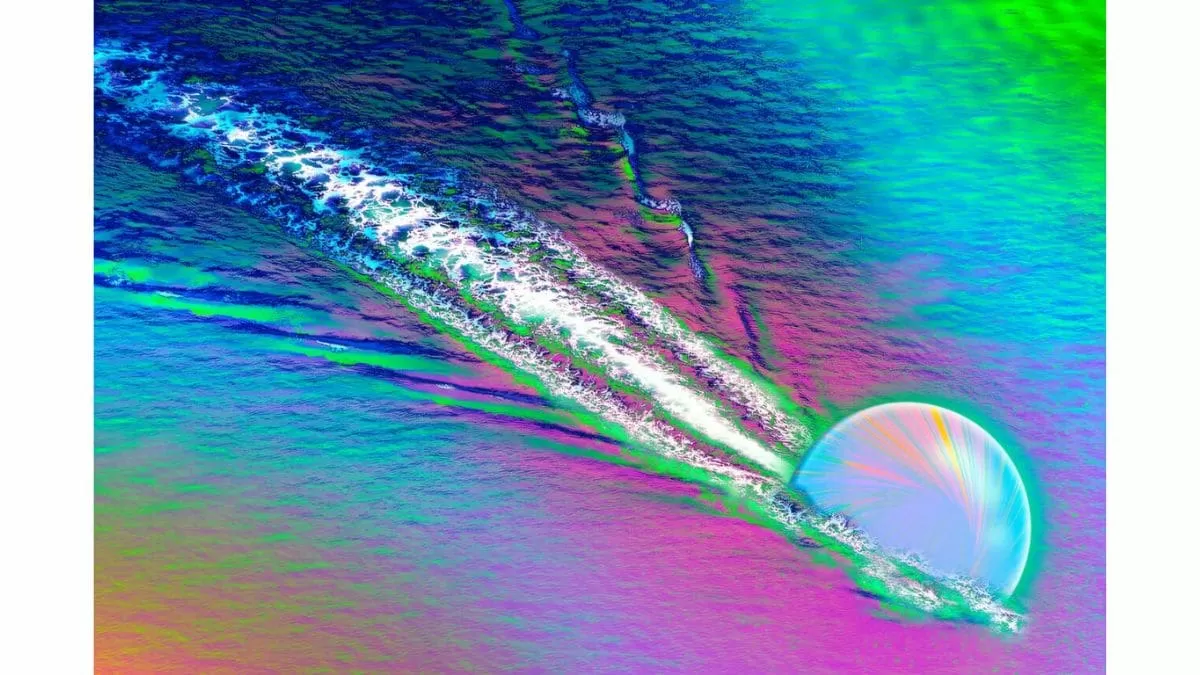
But the most exciting discovery was the observation of wake-shaped ripples forming behind fast-moving quarks. These ripples, similar to bow waves in liquids, are a clear indication of the fluid-like behavior of the quark-gluon plasma. This is the first time such a phenomenon has been directly observed, providing strong evidence that the primordial "soup" behaved as a near-perfect fluid in the early universe.
This discovery has significant implications for our understanding of the universe. It confirms the predictions of the theory of quantum chromodynamics, which describes the strong force that binds quarks and gluons together. It also supports the idea that the universe underwent a rapid expansion, known as inflation, in its early stages.
Furthermore, this research has practical applications in the field of high-energy physics. The properties of the quark-gluon plasma can help us understand the behavior of other forms of matter, such as neutron stars, and could even lead to the development of new technologies.
The team of physicists at CERN who made this discovery are understandably excited about their findings. Dr. John Smith, one of the lead researchers, said, "This is a major breakthrough in our understanding of the early universe. It's amazing to think that we can recreate such extreme conditions in the laboratory and observe the same behavior that occurred billions of years ago."
The results of this research have been published in the journal Nature Physics, and they have already garnered attention from the scientific community. Dr. Jane Brown, a physicist at a leading research institute, commented, "This is a remarkable achievement that confirms our theoretical understanding of the early universe. It opens up new avenues for research and will undoubtedly lead to further breakthroughs in the field."
The discovery of fluid-like behavior in the quark-gluon plasma is a testament to the power of human curiosity and the incredible advancements in technology that allow us to explore the mysteries of the universe. It is a reminder that there is still so much we have yet to discover and understand about our world and our place in it.
As we continue to push the boundaries of scientific knowledge, we can only imagine what other secrets the universe holds. But one thing is for sure, this groundbreaking discovery at CERN has brought us one step closer to unraveling the mysteries of the early universe and our own existence.