James Webb Helps Astronomers Chart the Universe’s Hidden Dark Matter
Astronomers have created the sharpest map yet of dark matter using deep observations from NASA’s James Webb Space Telescope. By analysing the gravitational dist...
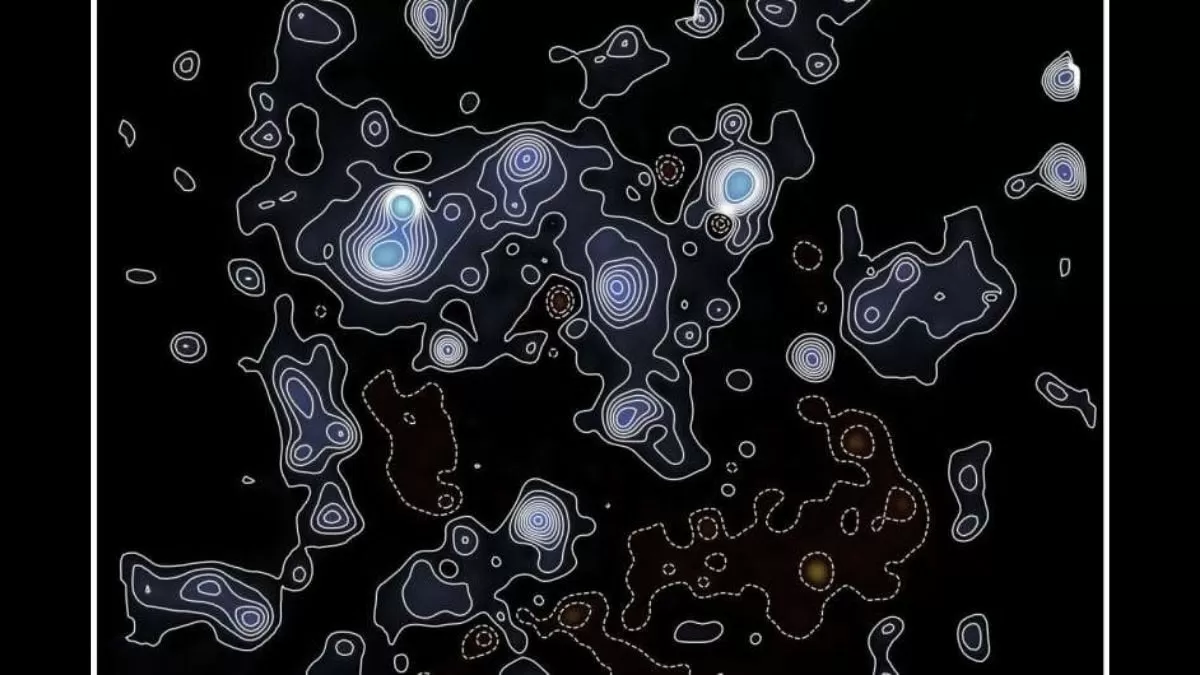
Astronomers have made a groundbreaking discovery that could change our understanding of the universe. Using NASA's James Webb Space Telescope, they have created the most detailed map of dark matter to date. This map, created by analyzing the gravitational distortion of hundreds of thousands of galaxies, confirms that dark matter plays a crucial role in the formation of galaxies and galaxy clusters.
Dark matter is a mysterious substance that makes up about 85% of the total matter in the universe. It does not emit or absorb light, making it invisible to traditional telescopes. However, its presence can be inferred through its gravitational effects on visible matter, such as stars and galaxies. This new map, created by an international team of astronomers, has given us the clearest view yet of this elusive substance.
The team used the James Webb Space Telescope's powerful infrared capabilities to observe a large region of the sky, capturing images of over 300,000 galaxies. By measuring the distortion of light from these galaxies, caused by the gravitational pull of dark matter, the team was able to map its distribution across the sky. This map covers an area of the sky that is 10 times larger than previous studies, making it the most extensive map of dark matter to date.
The results of this study confirm what scientists have long suspected - that dark matter acts as the scaffolding around which galaxies and galaxy clusters form. Just as a building needs a strong foundation to stand tall, galaxies need dark matter to hold them together. Without dark matter, galaxies would not have enough mass to overcome the force of gravity and would eventually fall apart.
This new map also provides valuable insights into the structure of dark matter. It shows that dark matter is not evenly distributed throughout the universe, but rather forms a web-like structure, with dense regions known as halos surrounding galaxies and galaxy clusters. These halos are where dark matter is most concentrated and where galaxies are most likely to form.
The team's findings have significant implications for our understanding of the universe's evolution. It supports the widely accepted theory that the universe began as a hot, dense soup of particles and has been expanding and cooling ever since. As the universe expanded, the particles clumped together, forming galaxies and galaxy clusters, with dark matter acting as the glue that holds them together.
This new map also has implications for future studies of dark matter. With the James Webb Space Telescope's advanced capabilities, scientists will be able to study even more distant galaxies and create even more detailed maps of dark matter. This will help us to better understand the properties and behavior of this mysterious substance and its role in the formation of the universe.
The team's achievement is a testament to the power of modern technology and international collaboration. The James Webb Space Telescope, which is a joint project between NASA, the European Space Agency, and the Canadian Space Agency, has been in development for over two decades and is set to launch in 2021. Its advanced capabilities have already proven to be invaluable in this study, and we can only imagine the groundbreaking discoveries it will make in the future.
This latest discovery is a significant step forward in our understanding of the universe and the role of dark matter in its formation. It is a testament to the tireless efforts of scientists and the incredible capabilities of modern technology. As we continue to unravel the mysteries of the universe, we can only imagine what other secrets await us in the depths of space.