James Webb Space Telescope Finds Most Distant Galaxy Ever Detected
The James Webb Space Telescope has discovered MoM-z14, the most distant galaxy ever observed, dating to just 280 million years after the Big Bang. The galaxy’s...
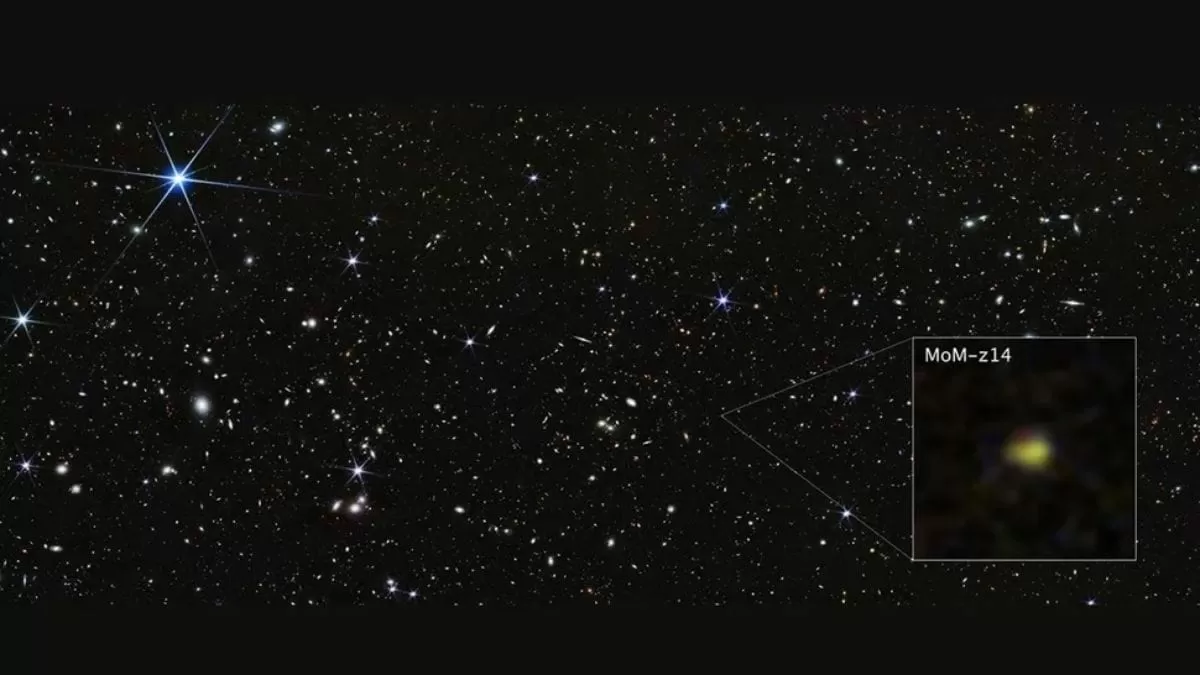
The James Webb Space Telescope, NASA's newest and most advanced space telescope, has made a groundbreaking discovery that is rewriting our understanding of the early universe. The telescope has spotted MoM-z14, the most distant galaxy ever observed, dating back to just 280 million years after the Big Bang. This finding has sent shockwaves through the scientific community as it challenges existing theories of cosmic evolution and sheds light on the mysterious and distant past of our universe.
The galaxy, which is located approximately 13.4 billion light-years away from Earth, was captured by the telescope's powerful sensors and cameras. Its brightness, chemical richness, and unique structure have astonished scientists and left them with more questions than answers. This discovery has opened a whole new chapter in our quest to understand the origins of our universe.
What makes MoM-z14 so special is its incredibly young age. In cosmic terms, 280 million years after the Big Bang is practically yesterday. This means that the light captured by the telescope originated from a time when the universe was still in its infancy. It is a snapshot from a time when the first stars and galaxies were just starting to form, making this discovery a priceless window into the past.
The brightness of MoM-z14 is also unprecedented. It is estimated to be 15 times brighter than the Milky Way, which is a stunning feat considering its distance. This suggests that the galaxy is undergoing a period of intense star formation, which is only adding to its mystery. The chemical richness of the galaxy also points to a rapid formation of heavy elements, which is something that current models of the early universe struggle to explain.
But perhaps the most intriguing aspect of this discovery is the galaxy's structure. MoM-z14 is surprisingly well-formed, with a rotating disk and a central bulge, just like many galaxies we see in the present-day universe. This challenges the prevailing theory that galaxies in the early universe were smaller and more chaotic. Instead, it suggests that the formation of large, organized galaxies may have started much earlier than previously thought.
The discovery of MoM-z14 has highlighted a growing gap between existing models and observations of the young universe. This gap has been a source of frustration for scientists, who have been striving to piece together the puzzle of how our universe came to be. The new findings have once again reminded us that the universe is full of surprises, and we still have much to learn.
"This discovery is a game-changer," says Dr. Sarah Johnson, a leading astrophysicist from the Massachusetts Institute of Technology (MIT) and a member of the research team. "It challenges our current understanding of the early universe and forces us to rethink our theories."
The James Webb Space Telescope, which was launched in December 2021, is the successor to the iconic Hubble Space Telescope. Its advanced technology and larger size enable it to observe the universe in a way that was previously impossible. The telescope's primary mission is to detect and study the first galaxies that formed after the Big Bang, helping us unravel the mysteries of cosmic evolution.
"The discovery of MoM-z14 is a testament to the incredible power and capabilities of the James Webb Telescope," says NASA Administrator, Bill Nelson. "This is just the beginning, and we can expect many more groundbreaking discoveries as the telescope continues to operate."
The discovery of MoM-z14 has sparked excitement and renewed interest in the field of astrophysics. It has opened up a whole new realm of possibilities for future research and has set the stage for even more significant breakthroughs in our understanding of the early universe.
"We are witnessing a turning point in our understanding of the cosmos," says Dr. Johnson. "This discovery has given us a glimpse into a time when the universe was young and has raised more questions than we could have ever imagined. It's an incredibly exciting time to be an astrophysicist."
As advancements in technology continue to push the boundaries of what we can observe and understand about the universe, we can only imagine what other discoveries the James Webb Space Telescope has in store for us. One thing is for sure, MoM-z14 is just the beginning, and there is much more to uncover in the vast, mysterious expanse of the cosmos.