Physicists Develop New Method to Detect Tiny Fluctuations in Spacetime
Physicists at the University of Warwick have developed a new framework to detect tiny spacetime fluctuations known as “quantum foam,” a long-standing prediction...
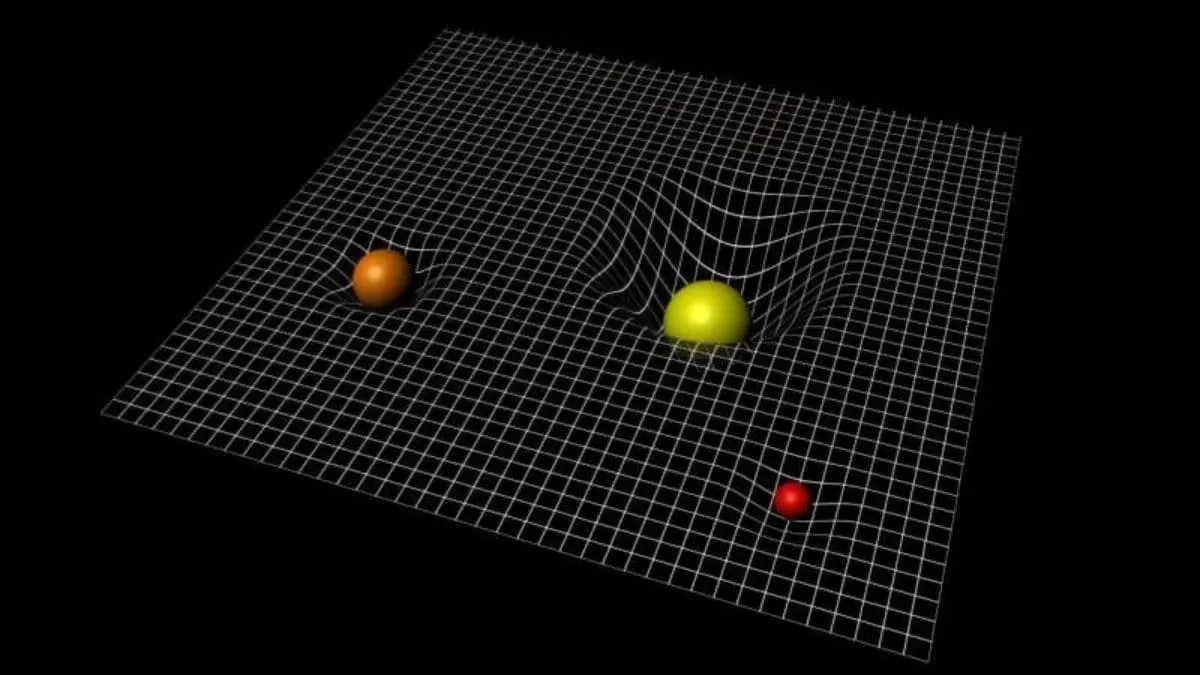
Scientists at the University of Warwick have made a groundbreaking discovery in the field of quantum gravity. They have developed a new framework that can detect tiny spacetime fluctuations, also known as "quantum foam." This has been a long-standing prediction of quantum gravity theories, and this new development brings us one step closer to understanding the fundamental nature of our universe.
The study, led by Professor Stefano Liberati and his team, maps different types of spacetime noise to measurable signals in interferometers such as LIGO and smaller laboratory setups. This means that the abstract theories of quantum gravity can now be translated into experimental signatures, making it possible to test them in the lab for the first time.
Quantum gravity is a branch of physics that aims to unify the theories of general relativity and quantum mechanics. While general relativity explains the behavior of large-scale objects, such as planets and galaxies, quantum mechanics deals with the behavior of subatomic particles. The challenge for physicists has been to find a theory that can explain both the large-scale and small-scale phenomena in our universe.
One of the key predictions of quantum gravity is the existence of "quantum foam," which refers to the idea that at a very small scale, spacetime is not smooth and continuous, but rather made up of tiny, constantly fluctuating bubbles. These fluctuations are so small that they are almost impossible to detect, but they are believed to have a significant impact on the behavior of particles and the structure of the universe.
Until now, the study of quantum foam has been purely theoretical, with no way to test its existence in a laboratory setting. However, the new framework developed by the team at the University of Warwick changes that. By identifying the different types of spacetime noise and their corresponding experimental signatures, they have opened up a realistic path towards testing quantum gravity in the lab.
This is an exciting development for the field of quantum gravity, as it brings us one step closer to understanding the fundamental nature of our universe. It also has the potential to revolutionize our understanding of gravity and could lead to new technologies and applications in the future.
The team's work has already garnered attention from the scientific community, with many experts praising the significance of their findings. Professor Giovanni Amelino-Camelia, a leading expert in quantum gravity, described the study as "a major step forward in the quest for a quantum theory of gravity."
The implications of this breakthrough are far-reaching. Not only does it provide a way to test quantum gravity theories, but it also opens up new avenues for research and exploration. It could also have practical applications in fields such as quantum computing and communication.
The team at the University of Warwick is now working on further refining their framework and conducting experiments to test its predictions. They hope that their work will inspire other researchers to join in the quest for a complete theory of quantum gravity.
In conclusion, the development of a new framework to detect quantum foam by physicists at the University of Warwick is a significant achievement in the field of quantum gravity. It brings us one step closer to understanding the fundamental nature of our universe and has the potential to revolutionize our understanding of gravity. With further research and experimentation, we may finally unlock the mysteries of quantum gravity and pave the way for new discoveries and advancements in science and technology.