Scientists Reveal Why Jupiter and Saturn’s Polar Weather Looks So Different
Although Jupiter and Saturn are similar gas giants, their polar weather patterns are strikingly different. Saturn hosts a single, massive hexagonal storm at its...
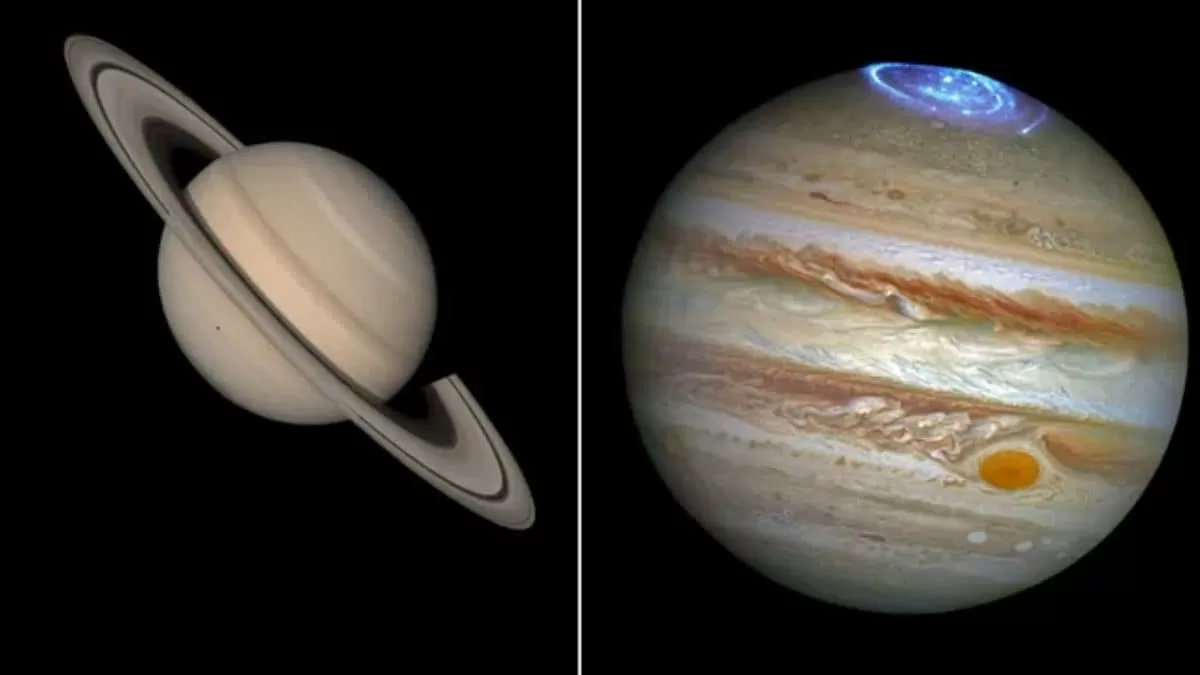
Jupiter and Saturn are two of the most fascinating planets in our solar system. These gas giants have captured our imagination for centuries with their massive size and beautiful rings. While they may seem similar at first glance, recent research has revealed a striking difference in their polar weather patterns. Saturn boasts a single, massive hexagonal storm at its north pole, while Jupiter features a central cyclone surrounded by smaller vortices. This stark contrast has puzzled scientists for years, but new simulations may finally shed light on the mystery.
The gas giants, Jupiter and Saturn, are composed mostly of hydrogen and helium, with a small amount of other gases. They have no solid surface, and their atmospheres are constantly in motion, creating intricate and ever-changing weather patterns. However, the polar regions of these planets have always been of particular interest to scientists. The hexagonal storm on Saturn's north pole was first discovered by the Voyager spacecraft in the 1980s, and it has been a subject of fascination ever since. On the other hand, Jupiter's polar regions have been observed to have multiple cyclones, but the reason behind this difference has remained a mystery.
Recent simulations conducted by a team of scientists from the University of California, Berkeley, and the University of California, Los Angeles, have provided a possible explanation for this striking contrast. The simulations suggest that the difference in the interior structure of these planets may be the key to understanding their polar weather patterns.
According to the simulations, Saturn's interior is denser and "harder" compared to Jupiter's. This means that the pressure and temperature inside Saturn are higher, creating a more stable and rigid environment. On the other hand, Jupiter's interior is softer, with lower pressure and temperature, allowing for more fluid motion. This difference in the interior structure could explain why Saturn's hexagonal storm is able to maintain its shape and dominance, while Jupiter's polar vortices are constantly changing and coexisting.
The team's simulations also showed that the hexagonal shape of Saturn's storm is not just a surface phenomenon, but it extends deep into the planet's interior. This suggests that the storm is not just a result of the planet's atmosphere, but it is also influenced by the planet's internal structure. This finding is significant as it challenges the traditional belief that the weather patterns on gas giants are solely driven by their atmospheres.
The simulations also revealed that the hexagonal storm on Saturn's north pole is not a recent occurrence. It has been present for at least 30 years, as observed by the Voyager spacecraft. This further supports the theory that the storm is sustained by the planet's interior structure, as it has remained stable for such a long period.
The team's findings have opened up new avenues for research and have provided a deeper understanding of the complex weather patterns on gas giants. It also highlights the importance of studying the internal structure of these planets, which has often been overlooked in the past.
The discovery of the possible link between the interior structure and polar weather patterns on Jupiter and Saturn is a significant step towards unraveling the mysteries of these gas giants. It also has implications for our understanding of other gas giants in our solar system and beyond.
The team's simulations have also raised questions about the formation of these planets. It is believed that gas giants form from the accumulation of gas and dust in the early stages of a solar system's formation. However, the simulations suggest that the internal structure of these planets may have played a crucial role in shaping their weather patterns. This could have implications for our understanding of the formation of gas giants and their evolution over time.
In conclusion, the recent simulations conducted by a team of scientists have provided a possible explanation for the striking difference in the polar weather patterns of Jupiter and Saturn. The contrast between Saturn's single, massive hexagonal storm and Jupiter's multiple polar vortices may be a result of their different interior structures. This discovery not only sheds light on the mysteries of these gas giants but also has implications for our understanding of the formation and evolution of gas giants in our solar system and beyond. With further research, we may be able to unlock more secrets of these fascinating planets and the universe as a whole.