
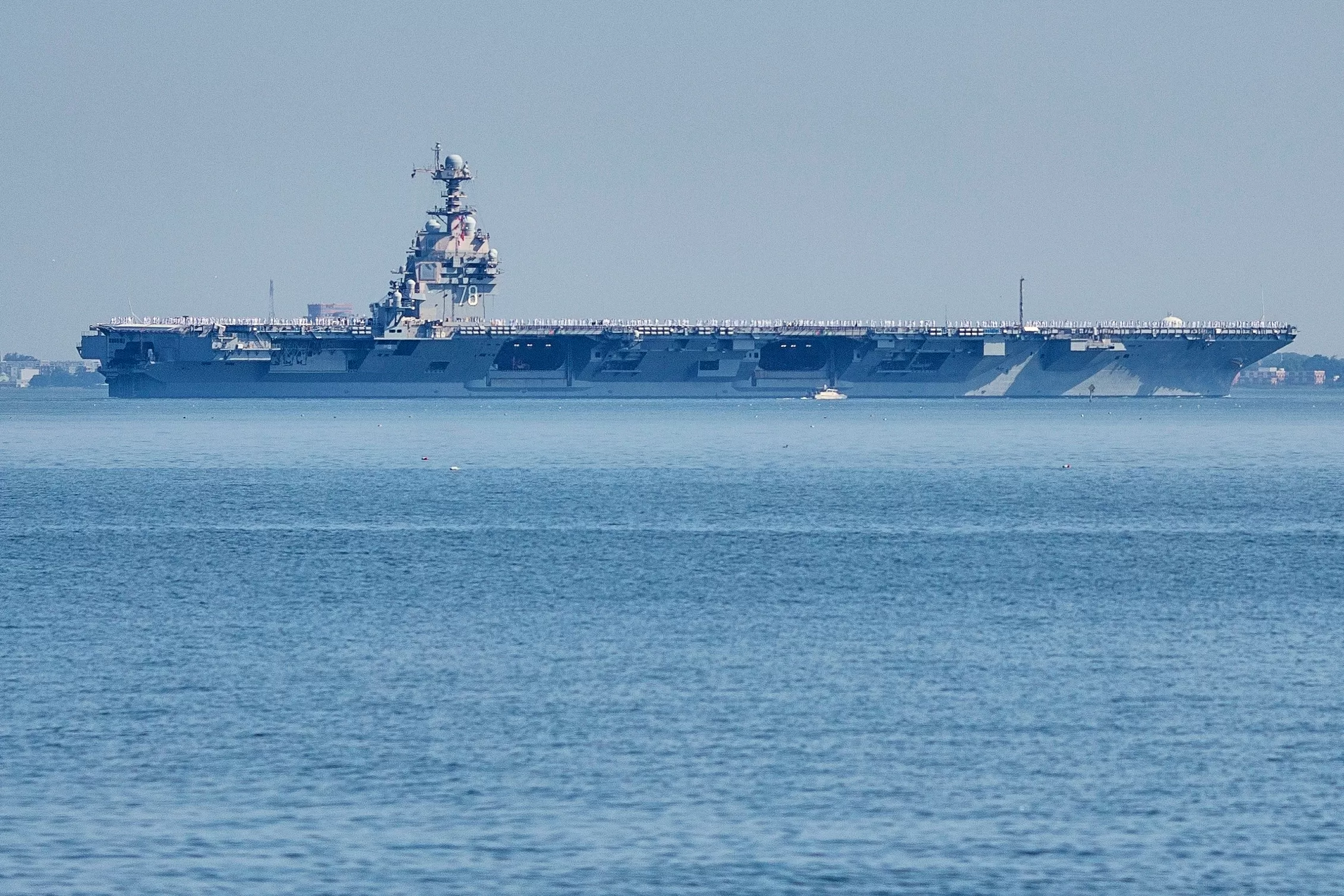
The United States military has announced a significant deployment in the Middle East, with three aircraft carriers operating in the region for the first time in over two decades. This move comes as the U.S. enforces its naval blockade against Iran in the Strait of Hormuz, a vital waterway for global oil trade.
The three aircraft carriers in question are the USS Abraham Lincoln, USS Gerald R. Ford, and USS George H.W. Bush. These massive warships, each capable of carrying over 60 aircraft and a crew of over 5,000, are a clear demonstration of the U.S.’s commitment to maintaining stability in the region.
The deployment of three aircraft carriers in the Middle East is a highly significant move, and one that has not been seen since the 1990s. It is a clear message to Iran that the U.S. is prepared to use its naval power to protect its interests and those of its allies in the region.
The U.S. has been increasing its military presence in the Middle East in recent months, citing threats from Iran and its proxies. The deployment of these three aircraft carriers is the latest in a series of actions taken by the U.S. to counter Iran’s aggressive behavior in the region.
The USS Abraham Lincoln, which was recently deployed to the region, has been conducting joint exercises with the U.S. Navy’s Fifth Fleet, based in Bahrain. These exercises, which involve air, surface, and subsurface operations, are aimed at enhancing the U.S.’s ability to respond to any potential threats in the region.
The USS Gerald R. Ford, the newest and most advanced aircraft carrier in the U.S. Navy, has also been deployed to the Middle East. This state-of-the-art warship is equipped with the latest technology and capabilities, making it a formidable force in any potential conflict.
The USS George H.W. Bush, the third aircraft carrier in the deployment, brings with it a wealth of experience and a long history of successful operations. This aircraft carrier has played a crucial role in various military operations, including the fight against terrorism in the Middle East.
The deployment of these three aircraft carriers is a clear demonstration of the U.S.’s commitment to maintaining peace and stability in the region. It also serves as a warning to Iran that any attempts to disrupt the flow of oil through the Strait of Hormuz will not be tolerated.
The Strait of Hormuz is a vital waterway for global oil trade, with over 20% of the world’s oil passing through it. Any disruption to the flow of oil through this narrow channel could have severe consequences for the global economy. The U.S.’s naval blockade is a crucial measure to ensure the safety and security of this vital trade route.
The deployment of three aircraft carriers in the Middle East also sends a strong message to U.S. allies in the region. It shows that the U.S. is committed to standing by its allies and protecting their interests in the face of any potential threats.
The U.S. has a long history of maintaining a strong naval presence in the Middle East, and the deployment of these three aircraft carriers is a testament to that. It is a clear demonstration of the U.S.’s military capabilities and its commitment to maintaining peace and stability in the region.
In conclusion, the deployment of three aircraft carriers in the Middle East by the U.S. military is a significant move that highlights the country’s determination to protect its interests and those of its allies. It serves as a warning to Iran that any attempts to disrupt the flow of oil through the Strait of Hormuz will be met with a strong response. The U.S.’s naval blockade is a crucial measure to ensure the safety and security of this vital trade route, and the presence of these three aircraft carriers will undoubtedly serve as a deterrent to any potential threats in the region.
